


Capterra offers objective, independent research and verified user reviews. We may earn a referral fee when you visit a vendor through our links.
Learn more
Our commitment
Independent research methodology
Capterra’s researchers use a mix of verified reviews, independent research and objective methodologies to bring you selection and ranking information you can trust. While we may earn a referral fee when you visit a provider through our links or speak to an advisor, this has no influence on our research or methodology. Learn more
How Capterra verifies reviews
Capterra carefully verified over 2.5 million+ reviews to bring you authentic software and services experiences from real users. Our human moderators verify that reviewers are real people and that reviews are authentic. They use leading tech to analyze text quality and to detect plagiarism and generative AI. Learn more
How Capterra ensures transparency
Capterra lists all providers across its website—not just those that pay us—so that users can make informed purchase decisions. Capterra is free for users. Software and service providers pay us for sponsored profiles to receive web traffic and sales opportunities. Sponsored profiles include a link-out icon that takes users to the provider’s website. Learn more
Project Management Software
Project Management software automates task assignment, resource allocation and milestone tracking for all phases of a project. Project Management tools and systems may take one of several approaches: collaborative, when multiple people work on a project; top-down, when one person works on a project at a time; or integrated, when multiple aspects of the organisation are involved. There are a variety of project management systems and tools that have been designed to fit your projects needs. Management software is related to Professional Services Automation software, Time and Expense software, Web Collaboration software and Workforce Management software. Its features include collaboration tools, file sharing, prioritisation, resource management, task management, project planning, project scheduling. Capterra also includes free management software listings. Find the best project management software for UK businesses. Read more Read less
Best Project Management Software in the UK for 2025
Project management software helps UK businesses organise workflows, plan projects, and manage tasks across teams. More than half (51%) of British project management professionals cite increased productivity and efficiency as the most beneficial aspect of using AI in project management [a]. With the large number of programs to manage projects available, each offering different costs, integrations, and tracking features, selecting the best solution can feel overwhelming.
To help you narrow down your options, I analysed 31,757 verified user reviews to highlight UK’s most popular and top rated project planning software. These tools are designed to support management, marketing, and content teams track and manage projects more effectively.
What you’ll find in this guide:
- The most critical features
- Value for money
- Pros and cons of each system
Get started
Explore the top project management software picks below or browse our full catalogue below to compare features, pricing, and user insights.
Top solutions

Jira

Basecamp

Asana

monday AI Work Platform

ClickUp

Smartsheet

Wrike

Notion
How we picked the software on this list
Our independent and objective research is based on market demand signals in the United Kingdom along with an analysis of our proprietary data.
This includes product information and verified user reviews in the last two years as of July 2025.
Sponsorship or client status has no influence on the selection of products in the lists, but it may impact the order in which products appear. Read our full methodology.
Highly Rated for Drag & Drop
Top rated feature:
Multiple Projects
Starting Price:
US$5.00/month
Free trial
Trello is rated 4.56 out of 5 stars and appreciated for its card-based, drag-and-drop interface that helps teams organise tasks and track progress visually. Its customisable boards and collaborative features support both personal and professional projects. Trello also integrates with popular tools and offers automation and calendar syncing, making it flexible for a wide range of organisational needs.
Features
- Task Management: Use Kanban-style boards and drag-and-drop tools to organise tasks across different project types. Boards can become cluttered with too many cards, and advanced needs may require external tools.
- Commenting/Notes: Leave comments, tag teammates, and add notes directly on cards to keep communication clear and contextual. Notifications may be inconsistent, and uploading or saving notes can occasionally be frustrating according to users.
- Project Planning/Scheduling: Set due dates, sync with Google Calendar, and use reminders to plan projects visually. Complex dependencies and Gantt charts aren’t supported natively, and setup can take time for larger projects.
- Collaboration Tools: Assign tasks, share boards, and collaborate in real time with integrations like Slack and Google Drive. Cross-board collaboration and feature access may be limited for larger teams.
- Task Progress Tracking: Track progress with lists, labels, and checklists for quick status updates. Advanced reporting and Gantt charts might require manual updates or add-ons.
- Activity Tracking: Monitor who did what with real-time updates and integrations like TrackingTime. Some users would expect easier access to summaries and more automation for tracking.
Pros & cons
Pros:
- Visual boards and intuitive interface: Easy to set up and navigate, even for non-technical users.
- Real-time collaboration: Teams can share updates instantly, making remote work smoother.
- Flexible workflows: Adaptable for different project types and team sizes.
Cons:
- Limited advanced features: Lacks tools for complex project tracking and reporting.
- Clutter with scale: Managing many cards or boards can become overwhelming.
- Notification issues: Alerts may be delayed or excessive, affecting focus.
Value for Money
4090 reviews discussing Value for Money, 79% positive.
Generous free plan, but premium features come at a cost
Trello’s free version includes unlimited cards, lists, and basic collaboration—ideal for individuals and small teams. Affordable upgrades unlock automation, integrations, and more customisation for growing needs. However, advanced features like calendar view and Gantt charts are limited, and premium plans may feel expensive for larger teams.
Popular Integrations
- Google Drive: Attach and share files directly on your Trello cards to centralise resources and streamline collaboration. — based on 329 reviews, 287 snippets.
- Google Calendar: Sync your tasks and deadlines with Google Calendar to keep due dates, reminders, and meetings in one place. — based on 177 reviews, 156 snippets.
- Gmail: Turn emails into tasks and receive Trello updates in your inbox to simplify communication and tracking. — based on 135 reviews, 110 snippets.
- Zapier: Automate workflows by connecting Trello with other apps, helping you save time and reduce manual work. — based on 120 reviews, 116 snippets.
- GitHub: Link pull requests, commits, and issues to Trello cards so you can track development progress more easily. — based on 94 reviews, 88 snippets.
Highly Rated for Kanban Board
Top rated feature:
Multiple Projects
Starting Price:
US$7.91/month
Free trial
Jira holds a 4.48 out of 5 stars rating and is valued for its flexibility in managing Agile workflows, software development, and business operations. You can customise workflows, use Kanban and Scrum boards, and track progress with robust reporting tools. Jira also integrates with Confluence and Bitbucket, and supports collaboration, automation, and visibility across teams of all sizes.
Features
- Task Management: Customise workflows and use clear dashboards to manage tasks with Agile methods like Scrum and Kanban. You may find the interface complex at first, and visualising task relationships can take time to learn.
- Task Progress Tracking: Track task status in real time with visual tools like Kanban boards and Gantt charts. Reporting setup can be tricky, and notification integrations may need improvement.
- Project Planning/Scheduling: Plan with backlogs, sprints, and boards that support both Agile and traditional methods. Scheduling for non-Agile projects is limited, and Gantt chart views could be more intuitive.
- Reporting/Project Tracking: Use built-in reports and dashboards to monitor progress and Agile metrics like burndown charts. Advanced reporting setup may be challenging, and filtering options aren’t always intuitive.
- Multiple Projects: Manage several projects with independent boards and centralised dashboards for cross-project visibility. Linking related stories across projects can be limited, and setup may require extra time.
- Prioritisation: Drag and drop tasks, set custom priority levels, and manage backlogs to focus on what matters most. Some users report a limited automation, and that priority order within sprints isn’t always enforced.
Pros & cons
Pros:
- Flexible workflows: Supports Agile methodologies and adapts to different team structures.
- Automation and dashboards: Streamlines task management and offers customizable views for tracking progress.
- Strong integrations: Connects easily with tools like Confluence, Slack, and GitHub to centralize work.
Cons:
- Complex setup: New users may face a steep learning curve due to interface and configuration.
- Performance with large datasets: Heavy data loads can slow down the platform.
- Pricing for small teams: Advanced features and scaling options may be costly for smaller businesses.
Value for Money
1632 reviews discussing Value for Money, 53% positive.
Scalable and feature-rich, but costs can add up
Jira’s free plan and entry-level pricing make it accessible for small teams starting out. You can benefit from strong customisation, automation, and integrations that support complex workflows and long-term growth. While costs can increase with more users or premium features, many users find the investment worthwhile as their needs evolve.
Popular Integrations
- Confluence: Link project documentation, requirements, and knowledge bases directly to Jira tasks to keep information connected and up to date. — based on 871 reviews, 763 snippets.
- Slack: Receive real-time ticket updates and create tasks from conversations to centralise communication and improve team collaboration. — based on 504 reviews, 434 snippets.
- Bitbucket: Connect code commits, branches, and pull requests to Jira tasks to streamline development and support continuous integration. — based on 468 reviews, 428 snippets.
- GitHub: Track code changes and link pull requests to Jira issues for better visibility into development progress. — based on 345 reviews, 287 snippets.
- Microsoft Outlook: Create tickets from emails and sync updates to manage communication and stakeholder collaboration through familiar tools. — based on 101 reviews, 72 snippets.
Highly Rated for File Sharing
Top rated feature:
Multiple Projects
Starting Price:
US$15.00/month
Free trial
Basecamp serves as a centralised workspace for managing projects, sharing files, and coordinating teams. Its dashboards, messaging tools, and reporting features help teams stay organised and aligned—whether working locally or remotely. The platform supports real-time updates and secure data management to simplify collaboration across projects.
Features
- Collaboration Tools: Includes tagging, commenting, and centralised message boards to support team communication. However, message threads can be confusing and adding collaborators isn’t always smooth.
- Task Management: Offers intuitive task assignment, due dates, and notifications to help organise work. Some users find it too basic for complex projects and miss subtasks or advanced input tools.
- Task Progress Tracking: Provides real-time visibility into task status and accountability. Progress tracking is mostly binary, with limited status options and occasional difficulty locating details.
- File Sharing: Supports fast file uploads, large documents, and folder organisation within projects. Integration with tools like Office 365 and Google Drive is limited, and version control could be improved.
- Project Planning/Scheduling: Enables straightforward setup, task assignment, and scheduling with notifications. Lacks advanced views like Gantt charts and may be less effective for large-scale projects.
- Reporting/Project Tracking: Delivers daily updates and clear overviews for basic tracking. Reporting is limited in customisation and can become difficult to manage across many projects.
Pros & cons
Pros:
- Unified workspace: Keeps teams organized with a central hub for tasks, messages, and files.
- Intuitive interface: Easy to navigate, making onboarding smooth for all team sizes.
- Collaboration tools: Reduces email overload and supports remote teamwork with built-in messaging.
Cons:
- Pricing for small teams: Flat-rate pricing may not be cost-effective for smaller businesses.
- Notification inconsistencies: Alerts can be delayed or overwhelming, affecting responsiveness.
- Limited flexibility: Security controls and version updates lack customization options.
Value for Money
1988 reviews discussing Value for Money, 68% positive.
Flat-rate pricing suits growing teams, but may not fit all budgets
Basecamp’s flat-rate model includes unlimited users and core features like chat, file sharing, and client access. It’s cost-effective for larger teams and offers free trials and plans for students and educators. However, small teams may find the pricing less flexible, and the free version has limitations.
Popular Integrations
- Gmail: Sends project updates and notifications directly to your inbox. This helps centralise communication and keeps correspondence organised. — based on 46 reviews, 41 snippets.
- Zapier: Automates workflows and connects Basecamp with third-party apps. This expands functionality and simplifies task creation from forms. — based on 37 reviews, 27 snippets.
- Harvest: Tracks time, manages expenses, and supports invoicing within Basecamp. This helps monitor project hours and finances in one place. — based on 11 reviews, 7 snippets.
- GitHub: Syncs issues and tasks to align development progress with project goals. This improves visibility between technical and non-technical teams.— based on 8 reviews, 8 snippets.
Highly Rated for Task Management
Top rated feature:
Multiple Projects
Starting Price:
£9.49/month
Free trial
Asana is a collaborative project and task management platform that helps you manage tasks, projects, and team communication with customisable workflows and automation. You can organise work across multiple views, track progress in real time, and integrate with popular tools. Asana supports both small teams and large organisations, offering flexibility for a wide range of project types.
Features
- Task Management: Organise tasks with subtasks, attachments, and deadlines using a clean, intuitive interface. You can switch between list, board, and calendar views, though some users mention a learning curve and occasional UI complexity.
- Project Planning/Scheduling: Break down projects into tasks and subtasks, assign deadlines, and track dependencies across multiple views. Templates and real-time updates support collaboration, but exporting views and managing subtasks’ visibility can be limited.
- Task Scheduling: Set deadlines, recurring reminders, and adjust workloads with calendar and timeline views. Bulk rescheduling and advanced scheduling features may require a paid plan, and Gantt charts are only available with a subscription.
- Task Progress Tracking: Track status updates, dependencies, and milestones with visual indicators and custom fields. You may want more granular progress bars or percentage tracking, but overall visibility supports team accountability.
- Collaboration Tools: Assign tasks, tag teammates, and comment directly to keep communication centralised. You can integrate with Slack, Google Drive, and Jira, though deeper collaboration may require external tools.
- Reporting/Project Tracking: Monitor progress with dashboards, status updates, and workload reports. Advanced reporting features are paywalled, and setup may take time, but integrations like Google Sheets help extend functionality.
Pros & cons
Pros:
- Customizable workflows: Teams can tailor project flows to match their processes and goals.
- Multiple project views: Switch between list, board, and timeline views to stay organized.
- Real-time updates: Instant notifications and changes keep everyone aligned.
Cons:
- Notification overload: Frequent alerts can be distracting or hard to manage.
- Single assignee limitation: Each task has only one assignee. You can assign the same task to multiple people, but it creates individual copies for each person, which can increase overall task volume.
- Pricing for advanced features: Higher-tier plans are needed to unlock key tools, which may not suit small teams.
Value for Money
2439 reviews discussing Value for Money, 75% positive.
Strong free plan, with scalable options for growing teams
Asana’s free tier supports up to 10–15 users and includes unlimited tasks, projects, and basic dashboards—ideal for small teams and startups. You can upgrade to unlock timeline views, custom fields, workload management, and advanced reporting. While premium plans may feel costly for larger teams, many users find the features and productivity gains justify the investment.
Popular Integrations
- Slack: Connects Asana with Slack to send real-time task notifications and create tasks from messages. This helps teams stay aligned without switching platforms. — based on 474 reviews, 439 snippets.
- Google Drive: Allows users to attach and access project files directly within Asana tasks. This centralises documentation and supports collaboration on frequently updated files. — based on 188 reviews, 139 snippets.
- Gmail: Converts emails into actionable tasks and manages attachments within Asana. This reduces manual entry and keeps communication organised. — based on 173 reviews, 132 snippets.
- Google Calendar: Syncs tasks with Google Calendar to track deadlines and receive reminders. This supports time management and team scheduling. — based on 142 reviews, 107 snippets.
- Microsoft Outlook: Enables task creation from emails and syncs tasks to calendars. This improves workflow efficiency and keeps project communication streamlined— based on 126 reviews, 126 snippets.
Highly Rated for Project Planning/Scheduling
Top rated feature:
Multiple Projects
Starting Price:
US$100.00/month
Free trial
monday.com is a work management platform that supports project tracking, task coordination, and real-time collaboration across teams. Its flexible dashboards, multiple workflow views (like Kanban and Gantt), and time tracking tools help businesses organise and automate work in one place. The platform integrates with popular apps to centralise communication and improve visibility across projects.
Features
- Multiple Projects: Supports managing several projects at once with customisable boards and multiple views. However, navigation and manual updates can become challenging as project volume increases.
- Task Management: Enables flexible task assignment, prioritisation, and real-time tracking. Some users note limitations in advanced dependency handling.
- Project Planning/Scheduling: Offers Gantt and calendar views, templates, and real-time updates for planning. Setup for dependencies and automation may feel less intuitive.
- Workflow Management: Provides visual workflows with automation and integrations like Google Drive and Trello. A learning curve and limited conflict resolution tools are common concerns.
- Customisable Fields: Lets teams tailor boards and fields to fit specific workflows. Some users find the options less robust or occasionally cumbersome.
- Collaboration Tools: Includes real-time chat, tagging, and file sharing with integrations like Google Docs and Dropbox. Collaboration with external users may be less seamless according to users.
Pros & cons
Pros:
- Real-time collaboration: Supports teamwork with instant communication, file sharing, and task assignment.
- Customizable workflows: Teams can tailor boards and automations to match their processes.
- Project planning tools: Multiple views and integrations help teams stay organized across functions.
Cons:
- Pricing for small teams: Advanced features often require higher-tier plans, which may be costly.
- Performance with large boards: Boards can slow down as data volume increases.
- Mobile limitations: The app lacks some functionality compared to the desktop version.
Value for Money
1239 reviews discussing Value for Money, 51% positive.
Flexible plans, but scaling costs add up
monday.com offers a free tier and trials, which help small teams test core features. It’s cost-effective for medium to large teams thanks to built-in templates and automation. However, the per-user pricing and feature restrictions on lower tiers can make it expensive as teams grow.
Popular Integrations
- Slack: Sends real-time notifications and task updates directly to Slack. This centralises communication and reduces missed information. — based on 226 reviews, 188 snippets.
- Gmail: Automates email notifications and converts emails into tasks. This streamlines follow-ups and keeps client communications organised. — based on 113 reviews, 53 snippets.
- Google Drive: Lets users attach, share, and preview documents within monday.com. This simplifies file management and supports team collaboration. — based on 104 reviews, 68 snippets.
- Microsoft Outlook: Syncs emails and calendars to automate reminders and track updates. This ensures smooth scheduling and communication. — based on 84 reviews, 67 snippets.
- Jira: Bridges workflows between technical and non-technical teams by syncing tasks and tracking dependencies. This supports comprehensive project oversight. — based on 78 reviews, 68 snippets.
Highly Rated for Activity Dashboard
Top rated feature:
Kanban Board
Starting Price:
US$10.00/month
Free trial
ClickUp holds a 4.63 out of 5 stars rating and is known for its flexible project and task management capabilities. It supports custom workflows, multiple project views, time tracking, goal setting, and automation—making it suitable for a wide range of business needs. With integrations, templates, and dashboards built to streamline work, ClickUp helps teams boost productivity across use cases like document management, CRM, and resource planning.
Features
- Task Management: Offers flexible task organisation with visual boards, comments, and file attachments. However, some users report UI sluggishness and occasional bugs.
- Project Planning/Scheduling: Includes Gantt charts, timelines, templates, and custom workflows to support planning. Advanced scheduling and automation may be limited on free plans.
- Task Editing: Enables real-time edits and bulk updates for efficient collaboration. Performance issues and too many clicks can slow down larger teams.
- Task Scheduling: Supports recurring tasks, calendar and Gantt views, and automated reminders. Rescheduling can be cumbersome, and free plans offer fewer view options.
- Multiple Projects: Allows cross-project visibility and customisable spaces for team collaboration. Navigation between projects and template imports may require improvement according to users feedback.
- Task Progress Tracking: Provides visual indicators, notifications, and custom views for tracking progress. Sync delays and cluttered interfaces are common concerns.
Pros & cons
Pros:
- Customizable workflows: Teams can tailor processes with automation, templates, and flexible task structures.
- Multiple project views: Switch between list, board, Gantt, and calendar views to suit different work styles.
- Affordable pricing: Free plan and low-cost tiers make it accessible for small businesses.
Cons:
- Notification management: Alerts can be hard to control, leading to distractions or missed updates.
- Mobile limitations: The app may lack key features found in the desktop version.
- Performance issues: Some users report slow load times and occasional bugs with large projects.
Value for Money
997 reviews discussing Value for Money, 84% positive.
Generous free plan with scalable upgrade options
ClickUp’s free plan includes unlimited tasks, project views, real-time chat, and collaboration for unlimited members—ideal for freelancers and small teams. Affordable upgrades unlock advanced features like time tracking, automations, and Gantt charts. Some users note that storage is limited on the free tier and per-user pricing can add up for larger teams.
Popular Integrations
- Slack: Sends real-time task notifications and updates directly to Slack. This keeps teams aligned and reduces the need to switch platforms. — based on 208 reviews, 178 snippets.
- Google Calendar: Syncs tasks with Google Calendar to manage deadlines and view schedules alongside events. This helps teams stay organised across devices. — based on 142 reviews, 103 snippets.
- Google Drive: Allows file attachments, previews, and sharing within ClickUp tasks. This streamlines document management and supports collaboration. — based on 102 reviews, 65 snippets.
- Gmail: Converts emails into tasks and attaches them to projects. This centralises communication and simplifies workflow management. — based on 83 reviews, 54 snippets.
- Zapier: Automates workflows and connects ClickUp with other tools. This helps trigger task updates and sync data across platforms. — based on 79 reviews, 65 snippets.
Highly Rated for Gantt/Timeline View
Top rated feature:
Multiple Projects
Starting Price:
US$9.00/month
Free trial
Smartsheet combines project management with a familiar spreadsheet-style interface. It supports task tracking, workflow automation, and reporting with tools like Gantt charts, forms, and custom dashboards. With cloud-based access and strong integration options, Smartsheet helps teams organise, monitor, and execute projects efficiently across industries.
Features
- Project Planning/Scheduling: Offers drag-and-drop planning, Gantt charts, templates, and automation to support scheduling. Calendar views and complex project handling may need improvement.
- Task Management: Enables task assignment, real-time tracking, and automated workflows with reminders. Resource allocation and large task list handling can be challenging.
- Task Editing: Supports quick, collaborative edits with real-time updates and attachment options. Saving and overwriting changes may occasionally cause issues.
- Multiple Projects: Centralises project management with dashboards and portfolio roll-ups. Linking complex projects can be difficult to manage.
- Reporting/Project Tracking: Provides real-time tracking, dashboard snapshots, and integrations with MS Project and Google Sheets. Setup complexity and limited formatting are common concerns.
- Customisable Fields: Allows tailoring of fields, forms, and templates to fit project needs. Advanced field options are limited compared to Excel.
Pros & cons
Pros:
- Excel-like interface: Familiar layout makes onboarding easier for teams used to spreadsheets.
- Customizable dashboards: Teams can tailor views, automate workflows, and track progress in real time.
- Collaboration tools: Centralized updates and task assignments support remote productivity.
Cons:
- Pricing for scale: Costs can rise for larger teams or access to advanced features.
- Sheet limitations: Row caps and formula complexity can restrict large-scale project management.
- Learning curve: Some users find setup and advanced functions harder to master.
Value for Money
577 reviews discussing Value for Money, 61% positive.
Strong value for complex projects, less ideal for light use
Smartsheet offers strong features and flexible licensing—only creators need paid accounts, while collaborators join for free. Its 30-day free trial and automation tools help reduce reliance on multiple platforms. However, pricing may feel high for small teams, and advanced features often require add-ons or higher-tier plans.
Popular Integrations
- Microsoft Outlook: Syncs calendars and uploads tasks from emails to centralise task management. This streamlines reminders and keeps project deadlines visible. — based on 68 reviews, 48 snippets.
- Jira: Connects development and project management teams by syncing tasks and automating ticket creation. This supports Agile workflows and unified reporting. — based on 53 reviews, 50 snippets.
- Microsoft Teams: Enables real-time collaboration and automated notifications within shared channels. This keeps project updates accessible and communication flowing. — based on 45 reviews, 41 snippets.
- Microsoft 365: Integrates with Office tools to enhance document sharing and streamline workflows. This allows seamless login and collaboration across productivity apps. — based on 34 reviews, 27 snippets.
- Google Drive: Links files directly to Smartsheet projects for easy storage, sharing, and collaboration. This simplifies document management across teams. — based on 33 reviews, 19 snippets.
Highly Rated & Free
Top rated feature:
Milestone Tracking
Starting Price:
US$10.00/month
Free trial
Wrike provides a project management platform that supports task tracking, workflow automation, and team collaboration through features like Gantt charts, Kanban boards, and real-time reporting. Its customisable dashboards and mobile app help teams stay aligned and make data-driven decisions. Wrike also integrates with tools like GitHub and Jira, making it suitable for businesses managing complex projects across departments.
Features
- Task Management: Create, assign, and track tasks with priorities, dependencies, and multiple views to keep your team aligned. Some users find the interface confusing, especially when switching between projects and folders.
- Project Planning/Scheduling: Use Gantt charts, timelines, and resource planning tools to manage complex schedules and improve visibility. Navigation can feel unintuitive, and exporting reports may require extra steps.
- Task Editing: Easily update descriptions, attach files, and track changes for seamless collaboration. Notifications can be inconsistent, and editing across teams may be challenging.
- Multiple Projects: Manage several projects at once using dashboards, folders, and Gantt charts. Setup can be complex, and viewing projects across spaces may need manual configuration.
- Task Scheduling: Schedule tasks with drag-and-drop tools, dependencies, and reminders to stay on track. Recurring tasks and automation features may be limited, and personal reminders are lacking.
- Calendar Management: Share and customise calendars to improve team visibility and resource allocation. Some users prefer external tools like Google or Outlook, and the calendar could be more polished.
Pros & cons
Pros:
- Advanced task and project management: Automations, tracking, and customizable workflows help teams stay organized.
- Collaboration tools: Shared workspaces and integrated communication support remote teamwork.
- Scalable structure: Adapts well to complex projects and growing teams.
Cons:
- Steep learning curve: Setup and navigation can be challenging for new users.
- Performance issues: Large projects may slow down the platform.
- Feature access: Some advanced tools require higher-tier plans or extra configuration.
Value for Money
507 reviews discussing Value for Money, 59% positive.
Strong features and flexibility, but pricing may limit smaller teams
Wrike offers solid project management tools, automation, and time tracking that help teams stay organised and deliver on budget. Its free plan and trial give small teams a chance to test the platform before committing. However, pricing can rise quickly for larger teams, and key features may require higher-tier plans.
Popular Integrations
- Microsoft Outlook: Convert emails into tasks and sync updates to reduce inbox clutter and improve project communication. — based on 80 reviews, 73 snippets.
- Slack: Receive instant notifications and centralise updates to keep your team aligned without switching platforms. — based on 52 reviews, 36 snippets.
- Google Drive: Share and edit documents directly in Wrike to streamline workflows and improve file access. — based on 42 reviews, 34 snippets.
- Microsoft Excel: Import and export tasks, generate reports, and move from spreadsheets to automated tracking. — based on 39 reviews, 35 snippets.
- Microsoft Teams: Access and update Wrike projects within Teams to boost visibility and real-time collaboration. — based on 37 reviews, 32 snippets.
Highest Rated
Top rated feature:
Multiple Projects
Starting Price:
US$12.00/month
Free trial
Notion is a project management platform with a high overall rating of 4.72 out of 5 stars. It combines note-taking, task tracking, databases, and collaboration tools in one customisable workspace. Its drag-and-drop interface and real-time editing support both individual productivity and team coordination. Notion’s adaptability makes it useful for building dashboards, managing workflows, and organising internal knowledge across teams.
Features
- Notes Management: Supports rich formatting, easy linking, and reusable templates for versatile note-taking. However, setup can be time-consuming, and some users want more customisation options.
- Knowledge Base Management: Organises internal knowledge with flexible structure, powerful search, and linked databases. Version control and database setup may require careful planning.
- Project Planning/Scheduling: Offers custom views, templates, and integrations with tools like Google Calendar and Figma. Some users mention a learning curve and limitations compared to specialised project management platforms.
- Task Editing: Enables real-time updates, drag-and-drop changes, and status tracking. Occasional slow loading and saving issues are reported.
- Task Management: Provides customisable task lists, Kanban boards, and collaboration tools. Automation is limited, and setup may be more complex than in dedicated task management tools.
- Collaboration Tools: Facilitates real-time editing, sharing, and permission control across teams. The free plan has limits, and advanced chat features or additional collaborators may incur extra costs according to users feedback.
Pros & cons
Pros:
- Flexible page creation: Customize layouts, embed media, and link content to organize work your way.
- Project and task management: Use templates and automation to streamline workflows and stay on track.
- Frequent updates: New features—including AI—keep the platform evolving and relevant.
Cons:
- Formatting and navigation: Text styling is basic, and navigating large databases can be unintuitive.
- Performance and mobile experience: Slowdowns occur with heavy data, and the mobile app lacks desktop-level polish.
- Offline access: Still limited, which can disrupt work when connectivity is an issue.
Value for Money
431 reviews discussing Value for Money, 70% positive.
Free plan makes it a cost-effective choice for small teams.
Notion offers strong value thanks to its generous free plan, which includes unlimited pages, basic blocks, and team collaboration. Compared to similar tools, its free and paid templates help reduce setup time and costs. Paid plans are affordable for individuals and small businesses, but advanced features and large-team support may require costly upgrades.
Popular Integrations
- Google Drive: Embed and access files directly in Notion to centralise documents and streamline collaboration. — based on 170 reviews, 108 snippets.
- Slack: Connect Slack to receive updates and coordinate tasks in real time, improving team communication. — based on 106 reviews, 74 snippets.
- Trello: Import Trello boards to manage tasks visually and unify workflows across platforms. — based on 103 reviews, 110 snippets.
- Asana: Link Asana to sync task lists and document projects, creating a transparent and unified workspace. — based on 55 reviews, 63 snippets.
- Zapier: Automate repetitive tasks and connect Notion with thousands of apps to save time and reduce manual work. — based on 42 reviews, 27 snippets.
Our full directory of Project Management Software solutions
Filter Results (1750)
Countries available
Show more details
Countries where the product is available. Note: Customer support may not be accessible in that country.
United Kingdom
Pricing Options
Product type
1750 results

Trello is an intuitive project management tool that creates a shared perspective for your team across the entirety of any project.
Trello is an intuitively simple project management tool, built so users can spend more time getting things done and less time learning how to use this tool. Teams that use Trello can easily organize their work and manage projects from beginning to end: assign tasks, manage due dates, attach files, create checklists, and more. With over 100+ integrations with other key tools like Google Drive, Slack, Jira, and more, Trello is a living, breathing project hub for cross-team collaboration.
Learn more about Trello
...
Read more
Features
- Milestone Tracking
- Time & Expense Tracking
- Issue Management
- Billing & Invoicing
- Gantt/Timeline View
- Kanban Board
- File Sharing
- Prioritisation
- Resource Management
- Budget Management
- Document Management
- Multiple Projects
Jira is a project management tool for all teams to collaboratively plan, track, and manage projects, customize workflows, and more.
Jira is a project management tool that provides a collaborative space to align on goals and priorities, track and measure work, and gain valuable insights that drive better outcomes for your teams. Every team in your organization — from product to marketing and beyond — is empowered with the flexibility to work the way they want. And by seamlessly bringing that work together, Jira allows you to manage projects cohesively in one place. Customize workflows to your team’s processes, integrate with numerous third-party apps, automate any task or process with a few clicks, and get rid of mundane tasks with AI. Jira provides cross-functional planning and visibility that aligns work to outcomes — so that every team is able to deliver big ideas, together.
Learn more about Jira
...
Read more
Features
- Milestone Tracking
- Time & Expense Tracking
- Issue Management
- Billing & Invoicing
- Gantt/Timeline View
- Kanban Board
- File Sharing
- Prioritisation
- Resource Management
- Budget Management
- Document Management
- Multiple Projects
Trusted by millions, Basecamp puts everything you need to get work done in one place.
NEW in Basecamp 4: For a limited time, get your first 3 users free, for your first year.
Group chat alone isn't enough. Basecamp combines *all* the tools teams need together in one place: message boards, schedules, to-do lists, group chat, documents & file storage, and more. Instead of stuff scattered all over, everything you're working on will be in one streamlined, organized place. Everyone will know what to do. Nothing will slip through the cracks. You'll always know exactly whats going on.
Learn more about Basecamp
...
Read more
Features
- Milestone Tracking
- Time & Expense Tracking
- Issue Management
- Billing & Invoicing
- Gantt/Timeline View
- Kanban Board
- File Sharing
- Prioritisation
- Resource Management
- Budget Management
- Document Management
- Multiple Projects
Improve Project Management with Asana AI. Tackle your complex workflows, get better insights and elevate teamwork efficiently.
Asana transforms Project Management with AI-powered features that streamline your workflows, deliver insights and enhance teamwork. Manage tasks, track performance and adapt quickly to changing priorities. With project templates, goal management and automated progress tracking, Asana ensures your team achieves its goals faster. Plus, you can use AI-driven insights to optimize resource allocation. Whether managing campaigns, onboarding or product launches, Asana empowers your organization to work smarter.
Learn more about Asana
...
Read more
Features
- Milestone Tracking
- Time & Expense Tracking
- Issue Management
- Billing & Invoicing
- Gantt/Timeline View
- Kanban Board
- File Sharing
- Prioritisation
- Resource Management
- Budget Management
- Document Management
- Multiple Projects
Manage projects easily: assign tasks, create estimates, visualize progress, and redistribute work and funds — with Clockify.
Clockify handles project management through Scheduling, Estimate, and Forecast features. Add employees, create projects, assign tasks, estimate time and finances, and visualize project progress. Add milestones, set custom project alerts, and reallocate resources to handle complex work in real time. Let Clockify calculate project funds automatically based on employee rates and scheduled hours, or enter fixed project fees.
Learn more about Clockify
...
Read more
Features
- Milestone Tracking
- Time & Expense Tracking
- Issue Management
- Billing & Invoicing
- Gantt/Timeline View
- Kanban Board
- File Sharing
- Prioritisation
- Resource Management
- Budget Management
- Document Management
- Multiple Projects

Bring your teams work together, and unify your workflow. Create, collaborate, and store information all in one place.
Evernote Business brings your teams work together. Create documents, collaborate on projects, and store information all in one place. Teammates can access, edit, upload, and share notes and files from any device--even if theyre offline. Cut through the noise, and quickly find the information you need with powerful search capabilities and integrations with tools you already use. Unify your workflow with Evernote Business.
Learn more about Evernote Teams
...
Read more
Features
- Milestone Tracking
- Time & Expense Tracking
- Issue Management
- Billing & Invoicing
- Gantt/Timeline View
- Kanban Board
- File Sharing
- Prioritisation
- Resource Management
- Budget Management
- Document Management
- Multiple Projects

GitHub enables development teams to collaborate, and review and manage code within a DevOps pipeline and built-in code security.
GitHub is where the world builds software. Millions of individuals, organizations and businesses around the world use GitHub to discover, share, and contribute software. Developers at startups to Fortune 50 companies use GitHub, every step of the way.
Learn more about GitHub
...
Read more
Features
- Milestone Tracking
- Time & Expense Tracking
- Issue Management
- Billing & Invoicing
- Gantt/Timeline View
- Kanban Board
- File Sharing
- Prioritisation
- Resource Management
- Budget Management
- Document Management
- Multiple Projects
Twyn CPQ: purpose-built telecom CPQ to design, price and quote SD-WAN, fibre, cloud and security in minutes.
Twyn CPQ is purpose-built Configure, Price, Quote software for telecom, ICT and managed service providers. Sales teams and solution architects design, price and propose complex solutions—SD-WAN, fibre, wireless, cloud, LAN, UC and security—without juggling spreadsheets, coverage tools and Word.
It finds customer sites from public data, RFPs or Excel; checks last-mile coverage across on-net and off-net providers; applies design-pattern guardrails so quotes stay valid; and generates branded proposals automatically. Flash journeys handle high-volume simple quotes. Guided journeys cover most network designs so specialists focus on complex deals.
A domain-specific catalogue manages offerings, bundles, price books, promotions and deal profitability without custom development. Supplier quote requests and approvals can be automated. Twyn connects to existing CRMs and to Twyn Order Management for a cleaner path from quote to fulfilment.
Learn more about monday AI Work Platform
...
Read more
Features
- Milestone Tracking
- Time & Expense Tracking
- Issue Management
- Billing & Invoicing
- Gantt/Timeline View
- Kanban Board
- File Sharing
- Prioritisation
- Resource Management
- Budget Management
- Document Management
- Multiple Projects
ClickUp is the world’s first Converged AI Workspace, bringing together all work apps, data, and workflows.
ClickUp is the world’s first Converged AI Workspace, bringing together all work apps, data, and workflows. ClickUp eliminates all forms of work sprawl to provide 100% context and a single place for humans and agents to work, together. Trusted by more than 20 million users worldwide, ClickUp is on a mission to maximize human productivity.
Learn more about ClickUp
...
Read more
Features
- Milestone Tracking
- Time & Expense Tracking
- Issue Management
- Billing & Invoicing
- Gantt/Timeline View
- Kanban Board
- File Sharing
- Prioritisation
- Resource Management
- Budget Management
- Document Management
- Multiple Projects

Confluence makes project management easier by keeping track of milestones and timelines all in one place.
Confluence makes Project Management easier by providing a connected workspace where teams can create, organize, and collaborate on all project documentation, track milestones and timelines, and keep everyone aligned—all in one place. Seamless integration with Jira ensures project transparency and helps teams ship faster.
Learn more about Confluence
...
Read more
Features
- Milestone Tracking
- Time & Expense Tracking
- Issue Management
- Billing & Invoicing
- Gantt/Timeline View
- Kanban Board
- File Sharing
- Prioritisation
- Resource Management
- Budget Management
- Document Management
- Multiple Projects
Smartsheet is an Intelligent Work Management Platform that revolutionizes how you manage projects, portfolios, and processes.
Smartsheet is an Intelligent Work Management Platform that revolutionizes how you manage projects, portfolios, and processes. The Smartsheet AI-powered platform delivers adaptability, sophisticated experiences, and enterprise-grade rigor to support work across industries, from service delivery to construction, clinical trials, and marketing campaigns. Designed to meet demanding requirements, it helps organizations drive efficiency, accelerate innovation, and stay competitive.
Learn more about Smartsheet
...
Read more
Features
- Milestone Tracking
- Time & Expense Tracking
- Issue Management
- Billing & Invoicing
- Gantt/Timeline View
- Kanban Board
- File Sharing
- Prioritisation
- Resource Management
- Budget Management
- Document Management
- Multiple Projects
Wrike is the AI-powered work delivery platform for project management allowing you to plan, execute, and deliver projects on time.
Wrike is the trusted work delivery platform where AI optimizes project management and extends what people can accomplish. By centralizing all projects in one governed, context-rich environment, Wrike helps organizations streamline collaboration, project planning, and task execution while maintaining the control and accountability that successful projects demand. Key features include AI Agents to build plans and assess risk, Wrike Copilot, workflow automations, customizable dashboards, Gantt charts, and advanced reporting. Powered by the Wrike Work Intelligence® Graph, every action becomes part of the auditable record of how work gets done. More than 20,000 organizations worldwide trust Wrike.
Learn more about Wrike
...
Read more
Features
- Milestone Tracking
- Time & Expense Tracking
- Issue Management
- Billing & Invoicing
- Gantt/Timeline View
- Kanban Board
- File Sharing
- Prioritisation
- Resource Management
- Budget Management
- Document Management
- Multiple Projects

Jotform Boards is a task management solution that makes it easy to capture and resolve customer and client requests.
Jotform Boards is a task management solution used to seamlessly capture and resolve customer requests. Auto-generate tasks from form responses, AI Agent customer conversations, workflows, and e-sign documents; customize task management boards; organize cards by groups and tags; assign team members; and so much more. Enjoy a drag-and-drop interface and kanban-style layout for task management made easy.
Jotform Boards is perfect for individuals looking to streamline their tasks or teams that want to collaborate smarter on customer requests. Your boards are accessible from any smartphone, tablet, or desktop computer, so you can truly manage your tasks from anywhere!
Learn more about Jotform
...
Read more
Features
- Milestone Tracking
- Time & Expense Tracking
- Issue Management
- Billing & Invoicing
- Gantt/Timeline View
- Kanban Board
- File Sharing
- Prioritisation
- Resource Management
- Budget Management
- Document Management
- Multiple Projects
Notion is the only project management software that connects your notes, projects, and wiki in one tool.
Notion is the only project management software that connects your notes, projects, and wiki in one tool. Tens of thousands of teams and companies around the world use it to keep their employees informed and working together in one place. By bringing all work and knowledge together and making it highly customizable, Notion creates focus and transparency, while consolidating tools, saving time, and driving more productivity for teams of all sizes.
Learn more about Notion
...
Read more
Features
- Milestone Tracking
- Time & Expense Tracking
- Issue Management
- Billing & Invoicing
- Gantt/Timeline View
- Kanban Board
- File Sharing
- Prioritisation
- Resource Management
- Budget Management
- Document Management
- Multiple Projects

Procore is a cloud-based construction management platform with a comprehensive set of products spanning the construction lifecycle.
Procore is the leading cloud-based construction management platform with a comprehensive set of products spanning the construction lifecycle, from pre-construction to project completion. One of the core benefits of Procore’s platform approach is that products are deeply integrated, providing a streamlined user experience and centralised access to project information. Procore’s mobile application allows customers and collaborators to access project data from the office or site.
Learn more about Procore
...
Read more
Features
- Milestone Tracking
- Time & Expense Tracking
- Issue Management
- Billing & Invoicing
- Gantt/Timeline View
- Kanban Board
- File Sharing
- Prioritisation
- Resource Management
- Budget Management
- Document Management
- Multiple Projects

Todoist helps small teams plan, organize, and deliver projects with clarity and focus, all in one simple workspace.
Todoist helps small and medium-sized teams plan, organize, and deliver projects with clarity and focus. It combines the power of project tracking with Todoist’s simple, intuitive design, so your team can manage deadlines, priorities, and progress without getting lost in complexity.
Create and assign tasks, add subtasks, set due dates, and organize work in list, board, or calendar views. Visualize project milestones, keep conversations tied to each task, and stay aligned with automatic reminders and recurring schedules.
Todoist integrates with tools your team already uses to keep everyone on the same page. Whether you’re managing team projects or cross-functional campaigns, Todoist helps you deliver work efficiently and maintain visibility across every stage of a project.
Built for growing teams that value simplicity, Todoist gives you the clarity to focus on results — not tool management.
Learn more about Todoist
...
Read more
Features
- Milestone Tracking
- Time & Expense Tracking
- Issue Management
- Billing & Invoicing
- Gantt/Timeline View
- Kanban Board
- File Sharing
- Prioritisation
- Resource Management
- Budget Management
- Document Management
- Multiple Projects

Toggl Track is time tracking software that helps boost productivity and revenue by offering customizable reports from team time data.
Toggl Track is a customizable time tracking software for small and large teams.
Our easy-to-use timer syncs tracking across multiple devices to track tasks and projects in real time. Teams can create detailed profitability and workload reports, export time logs as spreadsheets, get reports via email or share saved reports with public links with clients for additional transparency.
Toggl Track is available for web, desktop (Windows, Mac and Linux), and mobile (iOS and Android) and integrates with hundreds of invoicing and project management tools.
Learn more about Toggl
...
Read more
Features
- Milestone Tracking
- Time & Expense Tracking
- Issue Management
- Billing & Invoicing
- Gantt/Timeline View
- Kanban Board
- File Sharing
- Prioritisation
- Resource Management
- Budget Management
- Document Management
- Multiple Projects

Buildertrend is construction software for builders, remodelers, and contractors to track leads, projects, materials and finances.
Running a construction business means managing more moving parts than any single tool was built to handle — until Buildertrend. Trusted by 20,000+ contractors and used on more than half of all new home builds in the U.S., Buildertrend brings your projects, people, financials and clients into one unified platform. No disconnected tools. No blind spots. No reconciling information across systems that don't talk to each other.
From scheduling and job costing to client communication and change order management, every part of your operation runs from a single source. Real-time visibility protects your margins. A dedicated client portal keeps homeowners informed without pulling your team off productive work. And AI built into your workflows handles the busywork — so your team focuses on what moves the business forward.
Buildertrend is the system builders choose when they're ready to run a tighter, more profitable operation.
Learn more about Buildertrend
...
Read more
Features
- Milestone Tracking
- Time & Expense Tracking
- Issue Management
- Billing & Invoicing
- Gantt/Timeline View
- Kanban Board
- File Sharing
- Prioritisation
- Resource Management
- Budget Management
- Document Management
- Multiple Projects

Manage projects with speed and clarity in Airtable. Centralize work, align teams, and adapt plans in real time with flexible workflows.
Airtable is an AI-powered platform for project management, helping teams plan, track, and deliver work in one connected system—no code required. It replaces scattered tools with a flexible workspace where tasks, timelines, and dependencies stay organized and visible.
Teams can customize workflows, assign tasks, track progress, and visualize work across Gantt, Kanban, calendar, and timeline views—keeping everyone aligned and projects on schedule.
To keep work moving, Airtable’s built-in AI helps automate execution. Omni can generate complete project workflows from a prompt, while Field Agents can update statuses, summarize progress, and surface risks—reducing manual work across every task.
Airtable’s relational foundation keeps work connected, visible, and up to date across teams—so you can manage projects with greater speed, clarity, and control.
Learn more about Airtable
...
Read more
Features
- Milestone Tracking
- Time & Expense Tracking
- Issue Management
- Billing & Invoicing
- Gantt/Timeline View
- Kanban Board
- File Sharing
- Prioritisation
- Resource Management
- Budget Management
- Document Management
- Multiple Projects

Keep construction projects on track. Improve collaboration and empower teams to leverage current information. Reduce rework and risk.
Contractual procedures, communication processes, and standards can vary from one project to the next. Simplify the process with a single source of truth to streamline RFIs, change orders, and submittals. Meet deadlines more efficiently while still adhering to budgets.
Learn more about Autodesk Forma (formerly Autodesk Construction Cloud)
...
Read more
Features
- Milestone Tracking
- Time & Expense Tracking
- Issue Management
- Billing & Invoicing
- Gantt/Timeline View
- Kanban Board
- File Sharing
- Prioritisation
- Resource Management
- Budget Management
- Document Management
- Multiple Projects

The first and last business system you will ever need. NetSuite unlocks new growth by helping you maximise margins and harness new revenue streams.
The first and last business system you will ever need. NetSuite unlocks new growth by helping you maximise margins and harness new revenue streams. Automated, intelligent systems allow you to make better decisions and improve project success rates. Real-time analytics across the entire business helps you improve decision making, so you can rapidly adapt to changing revenue models.
Learn more about NetSuite
...
Read more
Features
- Milestone Tracking
- Time & Expense Tracking
- Issue Management
- Billing & Invoicing
- Gantt/Timeline View
- Kanban Board
- File Sharing
- Prioritisation
- Resource Management
- Budget Management
- Document Management
- Multiple Projects

Field project management connects jobs, tasks, schedules and crew hours in one shared workflow.
Field project management gets messy when schedules, job details and crew hours live in different places. ClockShark gives your office a central place to organize customers, jobs and tasks while field employees record time against the work they are completing. Managers see who is working, adjust schedules and review labor by job without stitching together separate timesheets and messages. Your team spends less time tracking down updates and gets a clearer record of project activity.
Learn more about ClockShark
...
Read more
Features
- Milestone Tracking
- Time & Expense Tracking
- Issue Management
- Billing & Invoicing
- Gantt/Timeline View
- Kanban Board
- File Sharing
- Prioritisation
- Resource Management
- Budget Management
- Document Management
- Multiple Projects

Meet project milestones in Miro, the #1 online collaborative whiteboard platform where teams get work done.
Miro is #1 collaborative whiteboard platform for teams of any size, trusted by over 13 million users worldwide. Easily collaborate, ideate and centralize communication for all your cross-functional team work.
Try our deep integrations with Microsoft Ecosystem, Atlassian Ecosystem, Slack, Box, DropBox, Sketch, and more to make your team collaboration more productive.
Explore 680+ templates and interactive frameworks to start collaborate quickly with your team
Learn more about Miro
...
Read more
Features
- Milestone Tracking
- Time & Expense Tracking
- Issue Management
- Billing & Invoicing
- Gantt/Timeline View
- Kanban Board
- File Sharing
- Prioritisation
- Resource Management
- Budget Management
- Document Management
- Multiple Projects

Resource management software for delivery teams—plan capacity, staff projects, and track delivery performance in one place.
Float is resource management software for delivery teams, designed to give operations and delivery leaders the full picture of who’s working on what, whether delivery is on track, and how to take on what’s next. Float offers a single, clear source of truth to plan, resource, and report on client work, working alongside existing CRMs, HRIS, project, and finance tools rather than replacing them. Real-time visibility into people, roles, and skills means teams always know who’s available and what’s coming next. Every project gets a baseline covering price, budget, roles, and timeline, with AI-assisted staffing to find the right person before work begins. When plans change, adjusted scope can be compared against the baseline to adapt quickly. Live reporting across capacity, utilization, actuals, margin, and budget burn keeps delivery performance visible as it happens. Creative agencies, professional services, and in-house delivery teams globally rely on Float to deliver client work.
Learn more about Float
...
Read more
Features
- Milestone Tracking
- Time & Expense Tracking
- Issue Management
- Billing & Invoicing
- Gantt/Timeline View
- Kanban Board
- File Sharing
- Prioritisation
- Resource Management
- Budget Management
- Document Management
- Multiple Projects

Hubstaff has trusted time tracking and project management for remote and field teams. Scheduling, invoicing, reporting, payroll, more.
Fight inefficiency and work better with project management from Hubstaff. Track time through simple desktop, web, and mobile apps, then manage projects, reporting, and more through one dashboard. Hubstaff integrates with over 30 apps so your business can run more efficiently, including Jira, Asana, Github, Slack, and Paypal. See work happen in real-time, track location with GPS and geofences, identify roadblocks and keep moving forward. Available for Mac, Windows, Linux, iOS & Android.
Learn more about Hubstaff
...
Read more
Features
- Milestone Tracking
- Time & Expense Tracking
- Issue Management
- Billing & Invoicing
- Gantt/Timeline View
- Kanban Board
- File Sharing
- Prioritisation
- Resource Management
- Budget Management
- Document Management
- Multiple Projects
Project Management Software Buyers Guide
Table of Contents
Essential project management software buying information
Project management software helps businesses plan, organise, and manage multiple projects, such as marketing campaigns, events, product and software releases, and construction projects. The software provides features to allocate tasks to individual contributors and teams, create project workflows, collaborate with team members, and reporting to track project and task progress.
Project managers and team members are the main users of project management software. This includes unofficial or informal project managers, such as construction managers or marketing agents who are coordinating project work.
When considering the cost of project management software, it is worth noting that most solutions on the market are priced on a "per month" basis, and their entry-level pricing plans range from $7 to $1,500 (approx. 5 to 1,100 GBP) per month.[1]
First-time buyers should begin evaluating options with a budget, number of users, specific use cases, and necessary integrations in mind. Partner with stakeholders on a list of important questions for vendors to help you evaluate their systems based on your needs, such as:
- Which project management tasks can this system automate?
- How can we use this tool’s dashboards to better visualise and track statuses of projects?
- How does this tool support our project management methodologies (e.g., agile, waterfall)?
- What level of technical support will I need from the project management software provider?
- Does this tool use artificial intelligence to generate status reports and/or enhanced resource planning? If so, how?
Hussain Bandukwala [2], a project management office (PMO) consultant and PM instructor who’s trained more than 100,000 professionals, says a question that “really stumps” many companies is how different licence types within a product work.
“With the advent of software as a service [models], you have different user-based license types,” he says. “So it’s important to understand what each license type gives you, plus their cost and limitations.”
What is project management software?
Project management software is a system designed to automate task assignment, resource allocation, and milestone tracking for all phases of a project. It helps create, assign, and track project work with features such as task management, project status report generation, budget tracking, and timeline tracking. Project management tools also help create resource allocation reports identifying resource overloads, imbalances, and availability constraints, allowing project managers to optimise resource allocation.
Project management software is related to the more robust project portfolio management software, as well as the more general-use tools including collaboration software and task management software.
Gartner reports that over 85% of businesses actively use project management software and the market is expected to reach a valuation of $7 million (approx. £5 million) by 2026.[3]
On Capterra, you’ll find 1,764 different project management products and 23,021 user reviews for these products have been added since September 2023 alone.[4]
Which software is best for project management?
According to our research, Notion is among the best rated in the category with a 4.72 out of 5 rating from over 2,584 verified user reviews from the past 2 years. Notion is praised for its all-in-one workspace combining notes, tasks, databases, and collaboration. Users like its intuitive interface, real-time collaboration, cross-platform access, and customisation. Notion supports individuals and teams with templates, integrations, and flexible organisation.
These are the main features:
- Notes Management: Users appreciate Notion’s rich formatting, easy linking, and templates for note-taking, though some find the initial setup time-consuming and want more customisation.
- Knowledge Base: Its flexible structure and powerful search make it easy to organise information, but reviewers mention challenges with version control and the need for thoughtful database setup.
- Project Planning/Scheduling: Notion offers customisable views, templates, and integrations (e.g., Google Calendar, Figma), but there’s a learning curve and some limitations compared to specialised project management tools.
- Task Editing: Real-time, intuitive task editing and drag-and-drop updates are praised, though occasional slow loading and minor saving issues are noted.
- Task Management: Customisable task lists, Kanban boards, and collaboration features are valued, but automation is limited and setup can be complex.
- Collaboration Tools: Users like real-time editing, easy sharing, and permission controls. However, the free plan has limits, there’s no advanced chat, and adding collaborators can incur extra costs.
How much project management software costs
Project management software typically follows a subscription model, billed monthly. For those starting out, entry-level plans are generally available around $200 (approx. 148 GBP) per month, offering essential tools such as task management, project planning and scheduling, tracking, and collaboration capabilities.
For more robust needs, advanced plans are available at approximately $1,400 (approx. £1,000) per month. These include the foundational features and offer enhanced functionalities like advanced analytics, custom integration capabilities, and prioritised customer support, designed to cater to more complex project demands.
Over the past two years, our advisors have found that the majority—57%—of project management software buyers are setting their budgets within the range of $20 to $40 (approx. £15 to £30) per month.[5]
First-time buyers must note that initial expenses often include implementation, data migration, and customisation costs, while ongoing expenditures typically cover maintenance and support services. These factors are crucial to consider for a comprehensive understanding of the total cost of ownership.
Project management software features rated by users
All project management software tools include task management, project planning/scheduling, and reporting/project tracking features. And most systems share a variety of common features such as prioritisation, billing and invoicing, and managing multiple projects.
Core project management software features
- Task management: Create tasks, track progress status and completion percentage and view any associated notes or comments. 91% rate this feature as critical or highly important.
- Project planning and scheduling: Create project plans, define project objectives, set milestones, and establish project timelines. 91% rate this feature as critical or highly important.
- Reporting/project tracking: Generate various reports and performance metrics to track progress, analyse data, and gain insights into project health and team performance. 84% rate this feature as highly important and critical.
- Collaboration tools: Provides a channel for team members to share media files, communicate, and work together. 80% rate this feature as highly important and critical.
Highly rated common project management software features
- Multiple projects: Ability to track and manage several projects simultaneously. 90% rate this feature as critical or highly important.
- Prioritisation: Arrange activities and tasks based on their relative importance or urgency to complete. 85% rate this feature as critical or highly important.
- File sharing: Public or private sharing of digital files of various formats such as documents, audio/video, images and more. 80% rate this feature as critical or highly important.
- Access controls and permissions: Define levels of authorisation for access to specific files or systems. 79% rate this feature as critical or highly important.
- Billing and invoicing: Create, manage, and send invoices or bills to customers. 67% rate this feature as critical or highly important.
Buyers should keep in mind that just because one product has more features than another, it doesn’t make it better for your business. Focus on how well a given system performs the key functions your team will use it for rather than putting too much value on bonus features that may not make a big difference for your business.
“If you don’t know what you are looking for in project management software, any software will look appealing to you,” notes Bandukwala. “That’s why understanding your own requirements is key. As the saying goes: if you don’t know where you’re going, any road will take you there.”
Project management software benefits identified by users
- Enhanced collaborative workspace: Enhances team interaction and collaboration through a unified platform that supports file sharing, real-time communication, and collective problem-solving, applicable in both remote and in-office settings.
“I love the team and collaborative workspace it allows for so that you can truly work remotely as an operational and efficient team.”
–Amanda H., business strategist, marketing and advertising
- Precision task management: Provides robust tools to meticulously organise and track tasks against critical project metrics like timelines, budgets, and scope, ensuring each team member has clear directives and responsibilities.
“Without this tool we would not have been able to properly organise all of the steps and milestones, and undoubtedly would not have had such success with each project we completed.”
–Mike H., CIO, education management
- Consolidated project insights: Consolidates all project-related documentation and communications into a single, continuously updated hub, making it simple to retrieve historical data and stay informed about current project statuses.
“I love that you can have task/project-related convos and attachments. This is excellent if you are like me and frequently need to show people where they made decisions in the past in an easy way.”
–Michelle M., manager, non-profit
- Workflow automation for peak efficiency: Streamlines the flow of project tasks and information, enforcing business process rules automatically to minimise oversights and boost efficiency, thereby solidifying foundational project management practices.
“In order to save time and cut down on mistakes, we have developed our own workflows, implemented reminders, and totally automated repetitive chores. We have achieved greater productivity and a more solid foundation for our performance processes.”
–Christian P., HR manager; health, wellness, and fitness
Amidst these core benefits, the integration of Generative AI has introduced a new layer of sophistication to these systems. This technological advancement has notably amplified the capability for detailed scenario planning, a feature that was already integral but is now becoming a standout aspect due to AI's influence.
Bandukwala explains: "Scenario planning for project portfolio management has already been in play, but the whole advent of Gen AI has really thrust everything into popularity, and made way for many new features to help users manage projects more effectively and efficiently." This evolution marks a significant shift in how project management tools are perceived and utilised, highlighting their increasing importance in strategic business functions.
Common challenges of project management software identified by users
UK project managers cite budget constraints (34%), limited access to real-time data or reporting (31%), and ineffective software tools (30%) as the top difficulties they expect in the next year.[6]
Navigating the landscape of project management software involves overcoming specific hurdles that can make or break the success of its implementation. It's crucial to understand the user-specific issues that arise when deploying these tools.
We've delved into user reviews from the past year to pinpoint common challenges faced by users, outlined below.
- Cost concerns: Balancing the budget against the need for advanced features can be tricky. High costs can deter initial investment, especially for smaller teams or startups.
Ask your vendor: What is included in the base price, and how do additional features affect the overall cost? Can you provide transparency on pricing tiers?
Overcome the challenge: Investigate options that offer scalable solutions—where you can start with basic features and add more as your budget allows.
- Complex user experience: An intricate interface can deter users from fully engaging with the software, limiting its effectiveness and reducing overall user satisfaction.
Ask your vendor: Can you describe the design philosophy behind your user interface? What steps have you taken to ensure the interface is intuitive?
Overcome the challenge: Opt for software that prioritises a clean, intuitive user interface. Evaluate the software through a trial period to ensure it meets the needs of your team’s workflow and enhances usability.
- Steep learning curve: New software can be daunting to learn, especially for teams accustomed to different processes. A steep learning curve can slow down adoption and reduce overall efficiency.
Ask your vendor: What training and support services do you offer to new users? How do you simplify the learning process for diverse teams?
Overcome the challenge: Choose software that not only provides comprehensive training materials like tutorials and webinars but also offers ongoing support.
While these challenges are significant, it's also important to recognise the potential benefits that come with successful implementation. For example, Bandukwala describes the potential risks and rewards of adopting AI and AI-related features in project management tools:
"There's excitement because there are so many possibilities—acceleration of pace, automation, suggestions, predictions,” he says. “But there are also natural apprehensions around potential roadblocks, such as integration issues, data quality, and ethical concerns."
What is project management software used for?
Analysis of our extensive project management software reviews highlight the most common use cases:
- Coordinating tasks across project teams: Businesses use project management tools to assign and track tasks at the individual and project level.
- Managing multiple projects: Project management software users can create and manage multiple projects within one tool, allowing individuals to see their tasks as assigned by due date or project.
- Optimising resource management: Project managers are able to assign team members to projects and tasks based on their availability, skillset, and business need.
- Analysing and tracking project status: Project management software users can view dashboards and generate reports at the individual, project, and, with some tools, program/portfolio level.
- Improving communication and collaboration: Teams and clients can communicate using built-in messaging and file sharing. The tool can send notifications to individuals, reducing reliance on email and enabling efficient collaboration, even for geographically dispersed teams.
Many project management software systems are designed to support specific methodologies and/or industries:
- IT project management software
- Project portfolio management software (typically designed for larger corporations and enterprises)
- Agile project management software
- Web-based project management software
Who uses project management software?
Project management software is widely adopted by a variety of professionals who rely on its robust capabilities to manage and streamline work tasks efficiently. Key users include marketing and sales teams, IT departments, construction managers, and personnel within non-profit organisations, each leveraging the software to suit their specific needs.
How different professions use project management software:
- Marketing and sales teams: They harness project management tools to organise campaigns, monitor progress towards sales targets, and manage interactions with prospects and customers.
- Information technology departments: These professionals use the software to manage software development projects, track updates, and maintain compliance with technical standards.
- Construction managers: They utilise project management tools to schedule work, control budgets, and coordinate communication between site managers and subcontractors.
- Non-profit organisations: Staff in these organisations apply the tools to manage fundraising events, coordinate volunteer schedules, and track grant application processes.
Analysis of more than 2,084 advisory calls conducted by Capterra’s advisors with project management software buyers since September 2023 reveals that with 62% of users coming from small businesses with fewer than 100 employees and about 65% of these businesses generating less than $25 million (approx. £18 million) in annual revenues, the role of project management software in supporting business operations across various sectors and company sizes is unequivocally affirmed.[5]
Common project management software integrations
We analysed our extensive reviews database and determined that the three categories most often integrated with project management systems are time clock, CRM (Customer Relationship Management), and task management. These integrations are crucial for enhancing the functionality and efficiency of project management software:
- Time clock: Allows for accurate time logging on tasks, which is essential for budget tracking, payroll, and assessing productivity. This integration helps ensure that project timelines are adhered to and labor costs are monitored closely.
- CRM: By connecting CRM systems with project management tools, businesses can streamline the flow of information between sales and project teams. This ensures that customer data and interactions are up-to-date and accessible.
- Task management: Allows for a more granular level of control over individual tasks and subtasks. This aids in distributing work evenly, setting clear expectations, and tracking progress, which collectively improve project outcomes.
These integrations not only bring data and processes together but also provide a unified view of operations, which can significantly enhance project efficiency and effectiveness.
Recent trends in project management software
Evolving project management with AI: Three-quarters of UK PMs are already using AI features and 85% see a positive ROI. Looking ahead, UK project managers believe that AI will have the greatest impacts on task automation, predictive analytics, and project planning in the next year.[6] The growing adoption of AI in project management software is also transforming the skill set needed for PMs in the UK. In this article, project manager coach Peter Taylor offers his insights on how companies can prepare the project managers to effectively work with AI.
The growing importance of emotional intelligence (EQ) in project management: Most (42%) UK project managers have moderately increased their use of EQ as a result of AI adoption[6]. As AI capabilities evolve and mature to handle administrative and technical tasks, the ability to navigate emotions, build strong relationships, and manage conflicts has become increasingly critical.
Sources
[a]. Impactful Project Management Tools Survey: Capterra's 2024 Impactful Project Management Tools Survey was conducted online in May 2024 among 2,500 respondents in the U.S. (n=300), Canada (n=200), Brazil (n=200), Mexico (n=200), the U.K. (n=200), France (n=200), Italy (n=200), Germany (n=200), Spain (n=200), Australia (n=200), India (n=200), and Japan (n=200). The study aimed to understand the leadership and emotional intelligence skills needed for PMs to successfully lead teams and projects, leveraging/incorporating AI. Respondents were screened to be project management professionals at organisations of all sizes. Their organisation must currently use project management software.
- Capterra software pricing data: Only products with publicly available pricing information and qualified software products within the category, as of the production date, are included in the pricing analysis. Currency conversions are based on the rate of the day of publication and may differ from current currency rates. Read the complete methodology.
- Hussain Bandukwala, LinkedIn
- Software Market Insights: Project Management, Gartner
- Capterra reviews data: Capterra reviews are collected from verified users for individual software products. This report analysed reviews from the past 2 years as of the production date. Number of products refers to our complete catalogue. Read the complete methodology.
- Capterra advisor call notes: Findings are based on data from telephonic conversations that Capterra’s advisor team had with businesses seeking project management software. For this report, we analysed reviews from the past year as of the production date. Read the complete methodology.
- Capterra’s 2025 Project Management Software Trends Survey: The 2025 Project Management Software Trends Survey was conducted in July 2025 to understand the PM methodologies and software that companies are using, their benefits and challenges, and the impact of AI on project management.
Project Management Software Trends
Table of Contents


Researched by content analyst David Jani and edited by Lindsay Page
AI and Security Reshape UK Project Management Software Decisions
Artificial intelligence (AI) is redefining what project management (PM) software can deliver, but it’s also introducing new risks, shifting buyer priorities, and accelerating decision-making, sometimes without enough strategic planning.
Capterra’s latest global survey reveals how organisations are adapting their PM strategies, investing in new tools, and responding to the growing influence of AI. In this article we will focus on how UK businesses are choosing to invest in project management software. We will see how there is a shift in buyer behaviour: AI is now the top trigger for software purchases, security is the leading concern, and emotional intelligence is emerging as a critical skill for project leaders.
Key takeaways
-
AI functionality is the top trigger for new PM software purchases: 59% of UK buyers say it drove their most recent investment.
-
Capability expansion is driving spend: 36% of UK firms increased budgets to adopt new tools, not just to cover rising costs.
-
Security is the top priority: 72% rank it as critical, and 51% say security concerns directly influenced their purchase.
-
Execution challenges persist: 48% of UK teams struggle with AI adoption due to issues such as skill gaps, onboarding issues, and workflow misalignment.
-
AI is raising the bar for people skills: 59% of UK PMs report increased use of emotional intelligence since adopting AI tools.
How do UK businesses use artificial intelligence in project management software?
AI can often be embedded in project management software used by UK businesses. It helps teams forecast risks, automate workflows, optimise schedules, and generate content such as meeting summaries or documentation. These capabilities are delivered through a range of AI technologies, not all of which serve the same purpose.
While many associate AI with chatbots or large language models (LLMs), that’s just one branch focused on generating human-like text. AI in PM software also includes predictive analytics, automation engines, and machine learning algorithms, each designed to support different aspects of project delivery. Together, they can help UK teams manage complexity, reduce manual effort, and make data-informed decisions.
Here’s a breakdown of the main types of AI used in project management software:
| Type of AI for project managers | What it does | Common use in PM software | Where it resides |
|---|---|---|---|
| Large language models (LLMs) | Generate human-like text | Drafting documentation, summarising meetings, answer questions | Standalone tools (e.g., PMI’s Infinity), integrated platforms, or plugins |
| Predictive analytics | Forecast outcomes using historical data | Risk prediction, delay forecasting, resource planning | Typically built into dashboards or reporting modules |
| Automation engines | Trigger actions based on rules or patterns | Task assignment, workflow routing, status updates | Embedded in the workflow engine |
| Machine learning algorithms | Learn from data to improve over time | Identifying patterns, surface blockers, optimise schedules | Integrated or offered as standalone analytics services |
Not all AI is created equal, and not all tools are transparent about how their AI works. UK buyers should ask vendors what kind of AI is being used, how it operates, and whether it’s explainable or a “black box.” Understanding these differences helps teams choose tools that genuinely support their workflows and decision-making.
AI influences project management software investment and shifts buyer focus
Artificial intelligence (AI) is now the leading reason why UK businesses invest in new project management (PM) software. In fact, 59% of UK buyers say the desire to add AI functionality was a trigger for their most recent software purchase. This isn’t about chasing flashy features. Instead, it reflects a strategic response to increasing project complexity, resource constraints, and the need for speed.
Where the money is going
UK organisations are investing more in PM software to expand capabilities, as 36% of UK respondents say they will increase spend specifically to adopt new software. This is notably higher than the global average of 30%.
Interestingly, adding users ranks lowest among UK buyers (2%), aligning with a broader trend of leaner teams. [1] Rather than hiring more staff, UK businesses are asking existing employees to do more with the resources they have. For project managers, this may mean relying on AI-powered tools to manage workloads, compensate for staffing gaps, and keep projects on track.
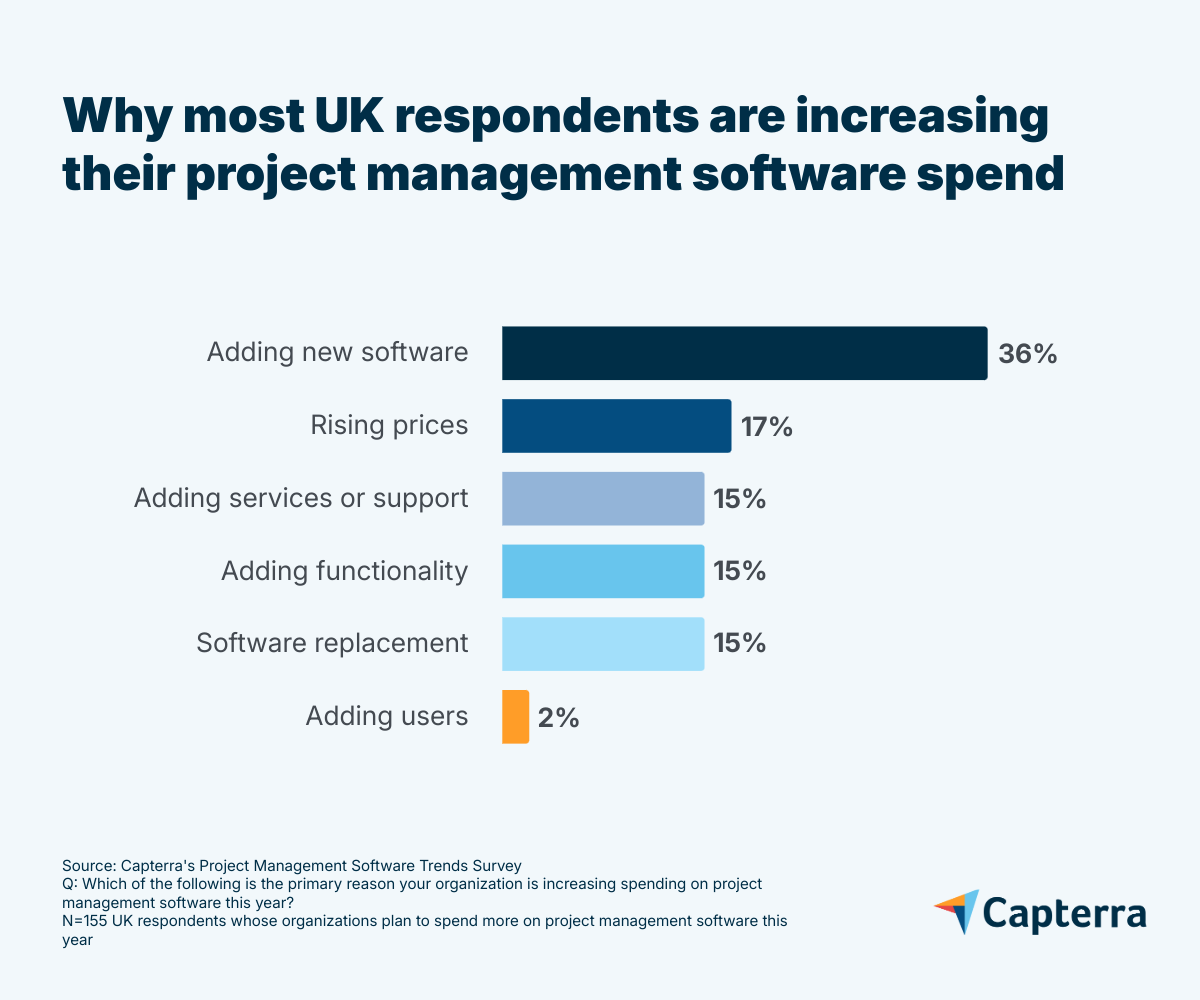
“The ROI shows up in time saved, reduced project overruns, and more accurate forecasting,” says Elizabeth Harrin [2], APM Fellow and author of Managing Multiple Projects. “PMOs can measure ROI by tracking time spent on admin tasks before and after AI implementation, reductions in schedule variance, or improvements in project success rates.”
Why it matters
Projects are becoming larger and more complex, [3] often spanning multiple teams, tools, and time zones. Manual coordination using spreadsheets or offline systems is no longer viable at this scale.
AI is setting new expectations. It’s already delivering measurable value in marketing, finance, and customer service, and PM leaders in the UK are under pressure to follow suit.
Teams are stretched thin. With fewer people and more work, UK project managers need help reducing administrative tasks, surfacing insights, and prioritising effectively.
The bigger story is adaptability. UK businesses face tight budgets, rising complexity, and long-term efficiency demands. They’re betting that AI can help them do more with fewer people and faster timelines.
“From a PMO perspective, the real value of AI lies in smarter decision-making, faster insight, and less manual effort,” says Lindsay Scott [4], co-founder of House of PMO. “That’s what PMOs believe will become a reality, but they’re not there yet.”
Expert recommendation
Don’t be swayed by AI buzzwords in vendor marketing. Not all tools offer the capabilities you need. Focus on products with practical, transparent features.
Ask vendors:
- How does your AI support planning, tracking, and decision-making?
- How does it integrate with our existing workflows?
The right investment can help UK teams stay competitive, but only if it’s grounded in real business needs.
Security becomes a top priority as AI reshapes project management tools
Even though AI enhances the functionality of PM software, it also introduces new risks. More data, more integrations, and more automation mean a broader attack surface, and UK buyers are paying attention. In the UK, 72% of respondents rate security as “critical” when selecting PM software, making it the top priority, ahead of functionality, integration or AI features.
Security concerns are not just theoretical. Over half (51%) of UK buyers say security issues directly triggered their most recent software purchase. This reflects growing awareness that PM tools are systems that store sensitive data such as budgets, contracts, client deliverables, and internal communications. AI adoption raises the stakes further, as predictive analytics and generative tools require ingesting and processing large volumes of project data, creating new integration points that could be exploited.
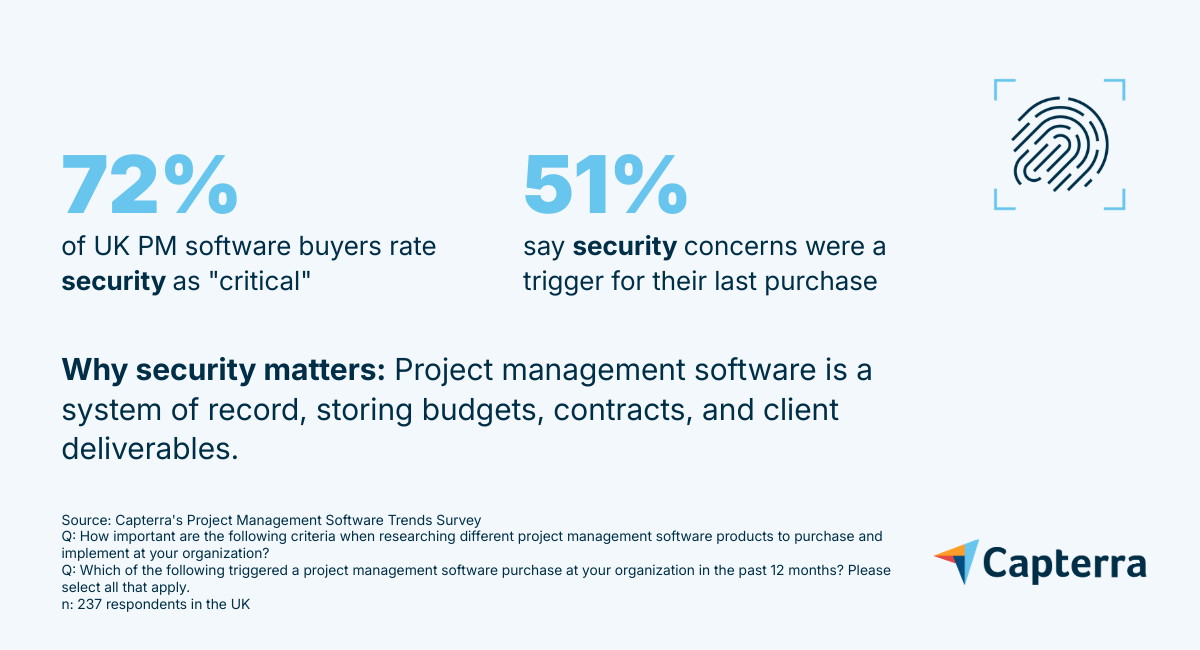
Harrin echoes the importance of adopting security measures in project management.
“Given the high-profile cyber incidents we’ve seen recently, security has to be a top priority,” she explains. “Project management software can include confidential and sensitive data, but any type of software could provide a route-in for hackers.”
Why security brings both satisfaction and dissatisfaction.
UK businesses find themselves in a point of tension. While they need security features like encryption, access controls and audit trails, they also expect ease of use. This dual demand is reflected in the fact that 47% of UK respondents cite security as a source of satisfaction, while 25% cite it as a source of dissatisfaction.
Real-world risk: Trello’s 2024 data breach
In July 2024, a hacker known as “Emo” leaked Trello user data on Breach Forums, exposing over 15 million email addresses, usernames, board memberships, and account settings. [5] The breach exploited an insecure API endpoint that allowed unauthenticated access to user data.
This incident underscores the vulnerability of collaboration and PM tools. As platforms become more integrated and AI-enhanced, the volume and sensitivity of data flowing through them increases, making weak access controls and poorly secured APIs a major liability and a potential target for cybercriminals.
Expert recommendation
UK buyers should scrutinise how vendors secure their APIs, monitor for suspicious activity, and protect user identities. Ask:
- Do AI features introduce new data flows or integrations?
- How are those governed and secured?
- Is an AI specialist required to configure security features, and is one provided?
Security must be treated as a core requirement, not a bolt-on feature, especially in tools that manage sensitive project and personnel data. PMOs must also assume their role in ensuring security by liaising accordingly with IT.
“While the PMO isn’t usually leading on security or data privacy, it does play a role in ensuring the tools and platforms it uses are fit for purpose,” says Scott. “It’s about due diligence, and making sure the right conversations happen with IT and infosec teams before any new tools are introduced.”
UK teams face greater challenges in unlocking AI’s full potential
Purchasing AI-powered project management tools is relatively straightforward. But making the most of them? That’s where UK teams are struggling. Nearly half (48%) of UK respondents say AI adoption issues are a top challenge with PM software. This is higher than the global average (41%).
Forty-one percent report a lack of AI skills on staff, and nearly as many (39%) say integrating new tools into existing workflows is a major hurdle. In the UK, this challenge is compounded by:
- Skill gaps: Many teams lack the expertise to use AI features effectively.
- Poor onboarding: Vendors often fail to guide users through setup.
- Workflow misalignment: New tools don’t always fit into existing systems.
“Demos aren’t enough to make sure that the tool is fit for purpose,” says Harrin. “Make time to have a real trial period. Often, the problem isn’t the tool; it’s the way it has been rolled out. Spending adequate time on change management is essential.”
These issues are slowing down value realisation. For example, 27% of UK respondents say correcting AI output is a major hurdle, highlighting the need for better training and clearer guidance.
To help buyers understand what’s slowing AI value realisation, here’s a breakdown of the most common barriers, examples, and what to do about them.
| Barrier to realising AI value | Example | What to do |
|---|---|---|
| Teams lack the skills to use AI features effectively. AI tools require new competencies like interpreting outputs and configuring automations. | A marketing agency ignored predictive scheduling due to a lack of training, reverting to manual planning. | Build AI literacy with role-based training and scenario-based workshops. Focus on practical use cases like task prediction and risk alerts. |
| Onboarding doesn’t support AI feature adoption. Failure to guide users through setup leaves teams unaware or underprepared on how to use the new capabilities. | A construction firm didn’t train managers on workflow setup, so automation was skipped, missing chances to focus on higher-value tasks. | Prioritise role-based training for all end users. Pilot with a small team to test usability before full rollout. |
| AI features don’t fit into existing workflows. New tools often require changes to how teams plan, track, and report work, especially when legacy systems are involved. | A healthcare practice’s AI assistant couldn’t access legacy CRM data, creating duplicate work. | Audit workflows before implementation. Choose tools that integrate with your existing stack and involve users early in rollout. |
Expert recommendation
Choose products that offer intuitive design and effective onboarding. Build internal training resources to help teams realise AI’s full potential. Ask vendors for role-based training materials and pilot programmes tailored to your team’s needs.
AI adoption boosts emotional intelligence among UK project managers
AI can generate plans, automate tasks, and surface insights—but it can’t build trust or resolve conflict. That’s why 59% of UK project managers say they’ve increased their use of emotional intelligence (EI) since adopting AI tools.
Why it matters
AI speeds up workflows, but it doesn’t fix misalignment, tension, or communication gaps. These remain the most human, and often the most difficult, parts of project management. As UK teams adopt more AI-powered tools, the need for strong interpersonal skills becomes even more critical.
What is EI?
Emotional intelligence is the ability to recognise, understand, and manage your own emotions—and those of others—to build trust and alignment. High-EQ project managers resolve conflicts, strengthen relationships, and keep teams focused and connected.
Top challenges amplified by AI and how EI helps:
-
Collaboration across teams (29%) High-EQ PMs clarify goals, ask deeper questions, and align departments..
-
Training new users (39%) They guide with patience and empathy when AI features feel unfamiliar.
-
Staffing gaps (16%) They keep teams focused and motivated when resources are stretched.
Expert recommendation
Invest in tools that help visualise dependencies, manage stakeholder input, and support cross-team alignment. Just as importantly, provide training in conflict resolution and strategic communication so UK project managers can lead effectively in AI-enhanced environments.
AI empowers UK project managers when implemented properly
Project management software is no longer just about managing task lists. For UK businesses, it’s increasingly about enabling adaptability, operational efficiency, and responsible use of AI. Organisations are investing in tools that help them work smarter, grow sustainably, and respond to change with confidence.
Scott backs this need for PPM software that goes beyond task management and enables strategic adaptability and operational efficiency.
“PMOs need robust data and reporting capabilities that support several different lenses, for example, portfolio oversight, resource forecasting, and benefits realisation,” says Scott.
What UK buyers expect from AI-powered PM tools
- Intelligent automation that saves time without compromising control
- Data security to protect sensitive information
- Straightforward onboarding for faster adoption
- Responsible AI that is transparent, ethical, and explainable
These expectations reflect a shift in buyer priorities. UK teams are looking for tools that not only deliver functionality but also support human decision-making and long-term resilience.
Methodology matters: hybrid approaches lead the way
Rigid methodologies are falling out of favour. Today, 47% of UK respondents use hybrid project management approaches, making it the most popular choice. This reflects a growing need for flexibility, especially as AI tools reshape how teams plan, track, and deliver work.
“Configurability is essential. Teams want to tailor workflows without paying for expensive custom builds,” says Harrin. “We’re seeing this through AI-powered process flows and mini-bots for workflows.”
What to watch
- Responsible AI: UK buyers expect transparency and control, not just automation.
- Security-first design: There’s growing scrutiny of how tools handle sensitive data.
- Soft skills surge: Emotional intelligence, negotiation, and strategic thinking are essential for leading in AI-enhanced environments.
- Workflow adaptability: Tools must support hybrid and custom methodologies to meet diverse team needs.
Final recommendation
Choose tools that support human decision-making, balance innovation with execution readiness, and scale with your business goals. The right PM software doesn’t just manage projects, it empowers people.
Recommended reading
Explore how UK project managers are using AI tools to boost efficiency, and what challenges they face around data quality and security
The article highlights how EQ-based techniques like empathy and self-awareness complement PM software to drive better outcomes.
The report reveals how UK businesses are driven by tech advancement FOMO, AI adoption, and rising cybersecurity needs, and how they shortlist vendors, evaluate tools, and avoid buyer’s remorse.
Methodology
* Capterra’s Project Management (PM) Software Trends Survey was conducted in July 2025 among 2,545 respondents in Australia (n=240), Brazil (n=227), Canada (n=227), France (n=241), Germany (n=224), India (n=216), Italy (n=227), Mexico (n=236), Spain (n=239), the U.K. (n=237), and the U.S. (n=231). The goal of the study was to understand the PM methodologies and software that companies are using, their benefits and challenges, and the impact of AI on project management. Respondents were screened for full-time employment at companies with more than one employee, working in management-level roles or above. Respondents were also confirmed to be at least partially responsible for PM software purchase decisions and operations within their organisation.
Sources
- What’s Causing Corporate Layoffs?, Knowledge at Wharton
- Elizabeth Harrin, Rebel's Guide to PM
- Megaprojects: Challenges, Opportunities, and the Role of the Project Profession, The Project Management Institute
- Lindsay Scott, House of PMO
- Trello Data Breach: Hacker Dumps Personal Info of Millions of Users, HackRead