Human Resources Software - Page 25
HR software, also known as Human Resource Software, HR Systems, or HRMS Systems, is a suite of tools that enable organisations to manage human capital. Human resources information software allows HR teams to manage a variety of necessary HR functions which include onboarding, employee benefits, attendance, salary, and more. Many Human Resource Management systems can be integrated with applicant tracking and payroll software platforms. HRMS is related to Applicant Tracking software, Payroll Software, Performance Appraisal software and Workforce Management software. Compare product reviews and features to help find the best HR Software for your business in the UK. Read more Read less


Features
- Performance Management
- Applicant Tracking
- Compensation Management
- Employee Management
- Recruitment Management
- Benefits Management
- Time & Attendance
- Payroll Management
- Onboarding

Features
- Performance Management
- Applicant Tracking
- Compensation Management
- Employee Management
- Recruitment Management
- Benefits Management
- Time & Attendance
- Payroll Management
- Onboarding
Local product

VireUp
Local product
Features
- Performance Management
- Applicant Tracking
- Compensation Management
- Employee Management
- Recruitment Management
- Benefits Management
- Time & Attendance
- Payroll Management
- Onboarding

Features
- Performance Management
- Applicant Tracking
- Compensation Management
- Employee Management
- Recruitment Management
- Benefits Management
- Time & Attendance
- Payroll Management
- Onboarding
Features
- Performance Management
- Applicant Tracking
- Compensation Management
- Employee Management
- Recruitment Management
- Benefits Management
- Time & Attendance
- Payroll Management
- Onboarding

Features
- Performance Management
- Applicant Tracking
- Compensation Management
- Employee Management
- Recruitment Management
- Benefits Management
- Time & Attendance
- Payroll Management
- Onboarding
Features
- Performance Management
- Applicant Tracking
- Compensation Management
- Employee Management
- Recruitment Management
- Benefits Management
- Time & Attendance
- Payroll Management
- Onboarding
Local product

Zelt
Local product
Features
- Performance Management
- Applicant Tracking
- Compensation Management
- Employee Management
- Recruitment Management
- Benefits Management
- Time & Attendance
- Payroll Management
- Onboarding
Features
- Performance Management
- Applicant Tracking
- Compensation Management
- Employee Management
- Recruitment Management
- Benefits Management
- Time & Attendance
- Payroll Management
- Onboarding

Features
- Performance Management
- Applicant Tracking
- Compensation Management
- Employee Management
- Recruitment Management
- Benefits Management
- Time & Attendance
- Payroll Management
- Onboarding

Features
- Performance Management
- Applicant Tracking
- Compensation Management
- Employee Management
- Recruitment Management
- Benefits Management
- Time & Attendance
- Payroll Management
- Onboarding

Features
- Performance Management
- Applicant Tracking
- Compensation Management
- Employee Management
- Recruitment Management
- Benefits Management
- Time & Attendance
- Payroll Management
- Onboarding

Features
- Performance Management
- Applicant Tracking
- Compensation Management
- Employee Management
- Recruitment Management
- Benefits Management
- Time & Attendance
- Payroll Management
- Onboarding

Features
- Performance Management
- Applicant Tracking
- Compensation Management
- Employee Management
- Recruitment Management
- Benefits Management
- Time & Attendance
- Payroll Management
- Onboarding

Features
- Performance Management
- Applicant Tracking
- Compensation Management
- Employee Management
- Recruitment Management
- Benefits Management
- Time & Attendance
- Payroll Management
- Onboarding

Features
- Performance Management
- Applicant Tracking
- Compensation Management
- Employee Management
- Recruitment Management
- Benefits Management
- Time & Attendance
- Payroll Management
- Onboarding

Features
- Performance Management
- Applicant Tracking
- Compensation Management
- Employee Management
- Recruitment Management
- Benefits Management
- Time & Attendance
- Payroll Management
- Onboarding

Features
- Performance Management
- Applicant Tracking
- Compensation Management
- Employee Management
- Recruitment Management
- Benefits Management
- Time & Attendance
- Payroll Management
- Onboarding

Features
- Performance Management
- Applicant Tracking
- Compensation Management
- Employee Management
- Recruitment Management
- Benefits Management
- Time & Attendance
- Payroll Management
- Onboarding

Features
- Performance Management
- Applicant Tracking
- Compensation Management
- Employee Management
- Recruitment Management
- Benefits Management
- Time & Attendance
- Payroll Management
- Onboarding
Features
- Performance Management
- Applicant Tracking
- Compensation Management
- Employee Management
- Recruitment Management
- Benefits Management
- Time & Attendance
- Payroll Management
- Onboarding

Features
- Performance Management
- Applicant Tracking
- Compensation Management
- Employee Management
- Recruitment Management
- Benefits Management
- Time & Attendance
- Payroll Management
- Onboarding
Features
- Performance Management
- Applicant Tracking
- Compensation Management
- Employee Management
- Recruitment Management
- Benefits Management
- Time & Attendance
- Payroll Management
- Onboarding
Features
- Performance Management
- Applicant Tracking
- Compensation Management
- Employee Management
- Recruitment Management
- Benefits Management
- Time & Attendance
- Payroll Management
- Onboarding

Features
- Performance Management
- Applicant Tracking
- Compensation Management
- Employee Management
- Recruitment Management
- Benefits Management
- Time & Attendance
- Payroll Management
- Onboarding
Human Resources Software Buyers Guide
Table of Contents
Essential HR software buying information
Human resources (HR) software enables organisations in the UK to manage employee records, digitise HR processes, and automate common HR tasks. HR software covers a wide variety of employee needs such as recruiting, payroll, benefits administration, and performance management.
HR software not only caters to large businesses with a robust HR department, but also to small businesses with no HR employees at all. In fact, one of the most common roles that contacts us about HR software are small-business owners. All UK industries purchase and use HR systems.
When comparing the best HR management systems, Jenn Tardy [1], a diversity recruitment consultant with years of experience, advises business leaders and decision-makers to think carefully before making a purchasing decision:
"You have to ask yourself what's more important to you: an interconnected system that gives you a broad view of all HR-related activities or specific systems that let you dive deeper into a specific topic.
"HR software is great if you're interested in the former, but it doesn't give you all the bells and whistles. For that, you'll need to look for specialised software, like recruiting or onboarding."
Most HR platforms are priced on a monthly subscription basis that scales based on the amount of functionality and the number of employees you have. Costs for HR software typically range from $360 (approx. 279 GBP) a month for an entry-level system up to $2,200 (approx. 1704 GBP) or more for a premium system. [2]
First-time UK HR software buyers have to consider their budget, number of employees, application requirements, use case, and any necessary integrations when making a purchase decision. Working with stakeholders to come up with a list of critical questions to bring to vendors can help you land on the best system for your needs:
-
What HR tasks can employees handle themselves through employee self-service?
-
What dashboards and analytics capabilities does the platform offer?
-
What level of technical support does the software provide?
-
How is artificial intelligence (AI) integrated into the platform, and how does it work?
What is HR software?
HR software is a category of software designed to help businesses manage and optimise their human resources processes. Through HR management software, users can perform HR tasks, store HR information, and analyse HR data.
“As your business becomes more sophisticated with data, business intelligence, and reporting, you’ll find yourself spending more and more money and resources integrating all of these disparate HR-related systems,” Tardy explains. “That’s where HR management software comes in; it’s much easier to make data-driven decisions because you can see everything in one place.”
Whether you’re recruiting job candidates, onboarding new hires, running payroll, administering employee benefits, tracking attendance, conducting performance reviews, or doing anything else related to talent management, there’s HR software out there that can support it. In fact, Gartner research shows that the worldwide HR software market grew 11.7% to $22.4 billion (approx. 17.3 billion GDP) in 2022. [3]
On Capterra, you’ll find 2,001 HR software products, making it one of the largest software categories we cover. Users have also submitted 16,154 HR software reviews in the past year alone [4] to help others identify the best HR software for their needs.
What are the best HR systems available in the UK?
According to our research, Deel is among the most popular UK HR systems, being best-rated in the category with 4.82 out of 5 rating from over 2,019 verified user reviews from the past 2 years. [5] Deel is designed to simplify global hiring, onboarding, and payroll management. It automates compliance, supports multiple currencies, and offers diverse payment methods, ensuring legal compliance across jurisdictions.
These are Deel’s main features:
-
Payroll management: Offers global compliance, automation, and various payment options, though some users find the interface less intuitive.
-
Electronic signature: Provides secure and efficient remote contract signing.
-
Direct deposit: Facilitates fast, secure international payments, despite occasional setup issues.
-
Self-service portal: Intuitive and user-friendly for managing payments and documents.
-
Document management: Centralised, secure storage for easy access to contracts and compliance documents.
-
Payroll reporting: Customisable reports for tracking payments and deductions.
Deel is praised for its robust payment management, supporting multiple currencies and compliance with local regulations, making it ideal for businesses with remote teams. It offers flexible withdrawal methods, an intuitive interface, and seamless integration with other tools, backed by responsive customer support.
How much does HR software cost?
Most HR software is priced on a monthly subscription basis that scales based on the amount of functionality and the number of employees you have. Costs for HR software typically range from $360 a month (approx. 279 GBP) for an entry-level system up to $2,200 (approx. 1,704 GBP) or more for a premium system.
Entry-level HR software includes core functions such as an employee database, basic HR function management, and reporting and analytics.
A more advanced HR solution that costs more typically includes additional features such as customisable reports, an employee self service portal, and an activity dashboard.
Sixty-four percent of the HR software buyers Capterra advisors spoke to in the last year are budgeting $5 to $10 (approx. 4 GBP to 8 GBP) per employee, per month. [6]
Tardy advises first-time buyers to be aware that:
-
Implementation, integration, and customisation are common upfront costs.
-
Maintenance and support are common recurring costs.
-
Training can be an additional expense.
If you’re looking for ways to save money on human resource manager software, you have a few options. Free trials are a great way to get some time with new software before making a purchase decision. Some vendors even offer free HR software outright, though buyers should be aware that there can still be costs associated with “free” software in the form of maintenance and customisation.
Lastly, HR software vendors may offer a discount if you opt for an annual subscription over a monthly one.
HR software features rated by users
All HR software tools include an employee database, HR management, and reporting and analytics features, and most have a variety of common features such as applicant tracking, payroll management, and onboarding.
Core HR software features
-
Employee database: Securely store and manage a database of employee information. 85% rate this feature as critical or highly important.
-
HR management: Automate core HR functions such as payroll, benefits administration, and compliance. 84% rate this feature as critical or highly important.
-
Reporting and analytics: View and track important HR metrics. 72% rate this feature as critical or highly important.
Common HR software features
Our analysis of proprietary reviews data reveals other common HR software features users rate as valuable:
-
Applicant tracking: Manage job applications and resumes as candidates move through the recruiting process. 81% rate this feature as critical or highly important.
-
Employee management: Track employee schedules, availability, and performance across projects and tasks. 81% rate this feature as critical or highly important.
-
Self-service portal: Gateway for employees to access HR software to perform tasks and find information. 79% rate this feature as critical or highly important.
-
Payroll management: Track and process employee payroll. 77% rate this feature as critical or highly important.
-
Onboarding: Automate the process of turning new hires into legal employees. 73% rate this feature as critical or highly important.
-
Time and attendance: Track employee work hours and time off balances. 71% rate this feature as critical or highly important.
-
360 feedback: Collect and track employee performance feedback from peers, managers, and direct reports.
-
Activity dashboard: View the status of ongoing processes, identify current incidents, and track past activities.
-
Compensation management: Track compensation budgets and optimise compensation structures for employees.
-
Customisable reports: Alter the layout and content of HR reports.
Top HR software benefits identified by users
- Improves HR performance and efficiency: Thanks to automation, digitised record-keeping, and employee self-service, users say HR software enables them to do more in less time.
“The capabilities provided by the platform have significantly streamlined our tasks and contributed to enhancing our overall efficiency.”
–Mara D., senior HR manager, nonprofit
- Facilitates small business growth: Managing a workforce gets complicated quickly as you grow. Users say their HR software has kept up with their growth and allowed them to scale their HR processes with ease.
“With our company growing from 150 to over 800 employees in the past 5 years, [our product] remains an essential partner in our success.”
–Julie G., HR and operations manager, food and beverage
- Provides a secure storage space for employee data: HR software reduces errors and security concerns associated with more manual methods, such as paper files and spreadsheets.
“It gives us a consolidated database of accurate employee information.”
–Jessica D., game programmer, computer software
Common challenges of HR software identified by users
Capterra’s 2025 Tech Trends Survey reveals some common challenges that UK HR software adopters expect to face in 2025. [7] Training and upskilling new employees is a big concern, with 38% highlighting the need for user-friendly software. Finding qualified talent is another challenge, cited by 35%, pointing to the need for effective recruitment tools. Implementing technologies smoothly is also on the radar for 32% of users, suggesting that seamless integration is key.
When selecting HR software, focus on identifying the right technology and addressing security concerns—both noted by 36% of adopters. Compatibility with existing systems is crucial too, with 35% mentioning it as a challenge. Therefore, it is important to prioritise solutions that are flexible and secure.
Vendor performance is also critical. Over a third (44%) of those regretting a purchase felt vendors overpromised. Therefore, when deciding on the best human resources system, consider prioritising vendors that provide good customer support; 50% of adopters say it’s essential for decision-making. Reliable support can make all the difference in successful HR software implementation.
What is HR software used for?
Analysis of our extensive HR software reviews highlight the most common use cases:
-
Managing a centralised employee database: Businesses use HR software to maintain a secure database of employee information, including name, role, salary, contact details, and more.
-
Tracking employee attendance and paid time off (PTO): HR software can help businesses track employee hours, through manual time logging or integration with time clock hardware.
-
Attracting, assessing, and hiring job seekers: Companies use HR software to post job openings, schedule candidate interviews, evaluate resumes, and track promising candidates through their recruiting and hiring workflow.
-
Automating payroll: Instead of doing the math and cutting paychecks manually, HR software can automatically calculate accurate wages and tax withholdings while depositing funds directly to employee bank accounts.
HR software generally falls into one of two categories: the “core HR” category or the “strategic HR” category.
The core HR category covers all the HR software that supports critical HR functions that every business has to perform. This includes:
-
Applicant tracking systems: Post job openings, manage job applications, assess candidate options, and track applicants as they progress through your recruiting process.
-
Onboarding software: Automate and manage the process of transitioning new hires into employees.
-
Payroll software: Run payroll, track compensation costs, and generate important payroll and tax reports.
-
Time tracking software: Track employee attendance, schedules, and billable hours for contractors.
-
Benefits administration software: Enroll employees in offered benefits, track their usage, and generate reports.
The strategic HR category covers HR software that helps businesses optimise their workforce or improve employee productivity and engagement. This includes:
-
Performance management software: Set individual employee goals, gather 360 feedback, and conduct performance reviews.
-
Learning management systems: Create, manage, and administer employee training and skills development modules.
-
Employee engagement software: Survey employees and diagnose common issues driving job dissatisfaction.
-
Compensation management software: Optimise compensation budgets and enable pay-for-performance.
-
Succession planning software: Identify high performers and develop a leadership bench for the future.
-
Workforce management software: Plan, track, and manage the allocation and requirements of labor resources.
-
HR analytics software: Aggregate employee data and visualise trends over time.
Depending on your needs, you may want to purchase a standalone HR system that performs a single function, or a comprehensive talent management suite that performs multiple functions.
Who uses HR software?
Companies from all types of industries leverage HR software to have more efficient HR processes, or because they’re lacking some sort of crucial HR functionality with their current methods.
HR personnel are the primary users of HR software, but they’re not the only ones. Managers use HR software to administer performance reviews, approve time off, and onboard new employees. Employees themselves also use HR software to update their contact details, see pay stubs, enrol in benefits, or do other HR-related tasks.
Notes from our advisor calls within the past year reveal that HR software buyers commonly come from small businesses with one to 24 employees and $5 million (approx. 3.9 million GBP) or less in annual revenue. One of the most common roles that contacts us about HR software isn’t even dedicated to HR, but rather small-business owners who lack a dedicated HR department.
Common HR software integrations
We analysed our extensive reviews database and determined the three categories that most often integrate with HR software as accounting software, document management software, and CRM software.
Buyers need a strong integration between HR and accounting software to run payroll. Document management software integration helps with managing employee handbook pages and job descriptions, while CRM software integration can feed accurate sales data to calculate commission pay.
Your integration requirements will depend on your size of business, based on our conversations with HR software buyers in the past year. While small businesses with one to 100 employees slightly favored standalone HR products (53%), larger businesses with 101 or more employees preferred integrated suites (66%). This is a typical progression as companies grow: They start off with a handful of standalone systems for core HR functions, such as payroll or employee scheduling, then work their way up to an integrated HR suite once their HR department has matured.
There are pros and cons with each approach. Piecemealing your HR software stack with a bunch of standalone systems will allow you to adopt a top-tier system for every HR function, but integrating them together could cause problems. Having an all-in-one HR software suite avoids any integration issues since all the functionality is housed in one platform, but you may have to compromise on functionality because suites can’t be best-in-class at everything.
Whatever direction you decide to go, it’s important to plan out what your HR software stack will look like ahead of time. Without proper planning, you may adopt systems that perform overlapping functions—adding unnecessary cost, training time, and vulnerabilities for security breaches. Because of these functional overlaps, 83% of HR employees told us they had plans to consolidate software applications within the next 12 months. [8]
Recent trends in HR software
-
AI technology is making waves in HR software: A growing number of UK-based employees are tapping into AI-driven tools within their HR departments, with nearly a quarter (24%) currently using such technology. These AI solutions are not only streamlining HR processes but are also gaining trust, as evidenced by 64% of UK employees believing in the reliability of AI for HR-related trainings. [9] However, as with any technology, it's crucial to thoroughly assess the capabilities and limitations of AI tools to ensure they meet the needs of both employees and the organisation before fully integrating them into HR operations.
-
Leadership development becomes a top priority: With 75% of HR leaders believing managers are overwhelmed and 70% reporting their current leadership programs are not preparing managers for the future, it is no surprise that leader and manager development is a top 2025 priority for HR leaders, according to Gartner’s annual HR Priorities survey. [10] HR departments are increasingly using software to develop managerial training modules, connect new managers with mentors, and diagnose areas where managers are struggling the most.
-
Pay transparency goes mainstream: Salary transparency is crucial to attracting top talent. In fact, a quarter (25%) of U.K. job seekers have stopped an interview process or declined an offer because the salary was too low. [11] Companies are now using payroll and compensation management systems to ensure salaries are competitive in their region.
Learn more about how HR software can help your business
-
How to implement AI for recruiting without sacrificing candidate experience
-
4 Insights for improved technology adoption and employee satisfaction
Sources
- Jenn Tardy, LinkedIn
- Capterra software pricing data: Only products with publicly available pricing information and qualified software products within the category, as of the production date are included in the pricing analysis. Currency conversions are based on the rate of the day of publication and may differ from current currency rates. Read the complete methodology.
- Market Share Analysis: Human Capital Management Software, Worldwide, 2022, Gartner
- Capterra reviews data: Capterra reviews are collected from verified users for individual software products. For this report, we analysed reviews from the past year as of the production date. Number of products refers to our complete catalogue. Read the complete methodology.
- Capterra reviews data: Capterra reviews are collected from verified users for individual software products. For this report, we analysed reviews from the past year as of the production date. Read the complete methodology.
- Capterra advisor call notes: Findings are based on data from telephonic conversations that Capterra’s advisor team had with small-to-midsize businesses seeking HR tools. For this report, we analysed phone interactions from the past year as of the production date. Read the complete methodology.
- and [a]. Capterra’s 2025 Tech Trends Survey: The 2025 Tech Trends Survey was conducted in August 2024 to understand the timeline, organisational challenges, adoption & budget, vendor research behaviours, ROI expectations, and satisfaction levels for software buyers.
- Capterra's 2023 HR App Sprawl Survey: The 2023 HR App Sprawl Survey was conducted in March of 2023 to learn more about experiences with software application overlap and redundancies among HR employees from small to medium-sized businesses.
- Capterra’s 2023 Employee Exit Survey: The 2023 Employee Exit Survey was conducted in May to June of 2023 to understand the process of lay-offs in companies and their impact on employee morale.
- Top 5 HR Trends and Priorities That Matter Most in 2025, Gartner
- Capterra’s 2024 Job Seeker AI Survey: The 2024 Job Seeker AI Survey was conducted in July 2024 to understand the factors in AI-driven recruiting processes, and how prevalent AI tool usage is among job seekers.
Human Resources Software Trends


Navigating the New HR Landscape
HR is changing fast. Finding and keeping top talent is harder than ever in today’s unpredictable world. Rising costs, skills gaps, and the rise of artificial intelligence (AI) are forcing HR leaders in the UK to rethink how they manage people. In this high-stakes environment, technology isn’t just helpful—it’s essential.
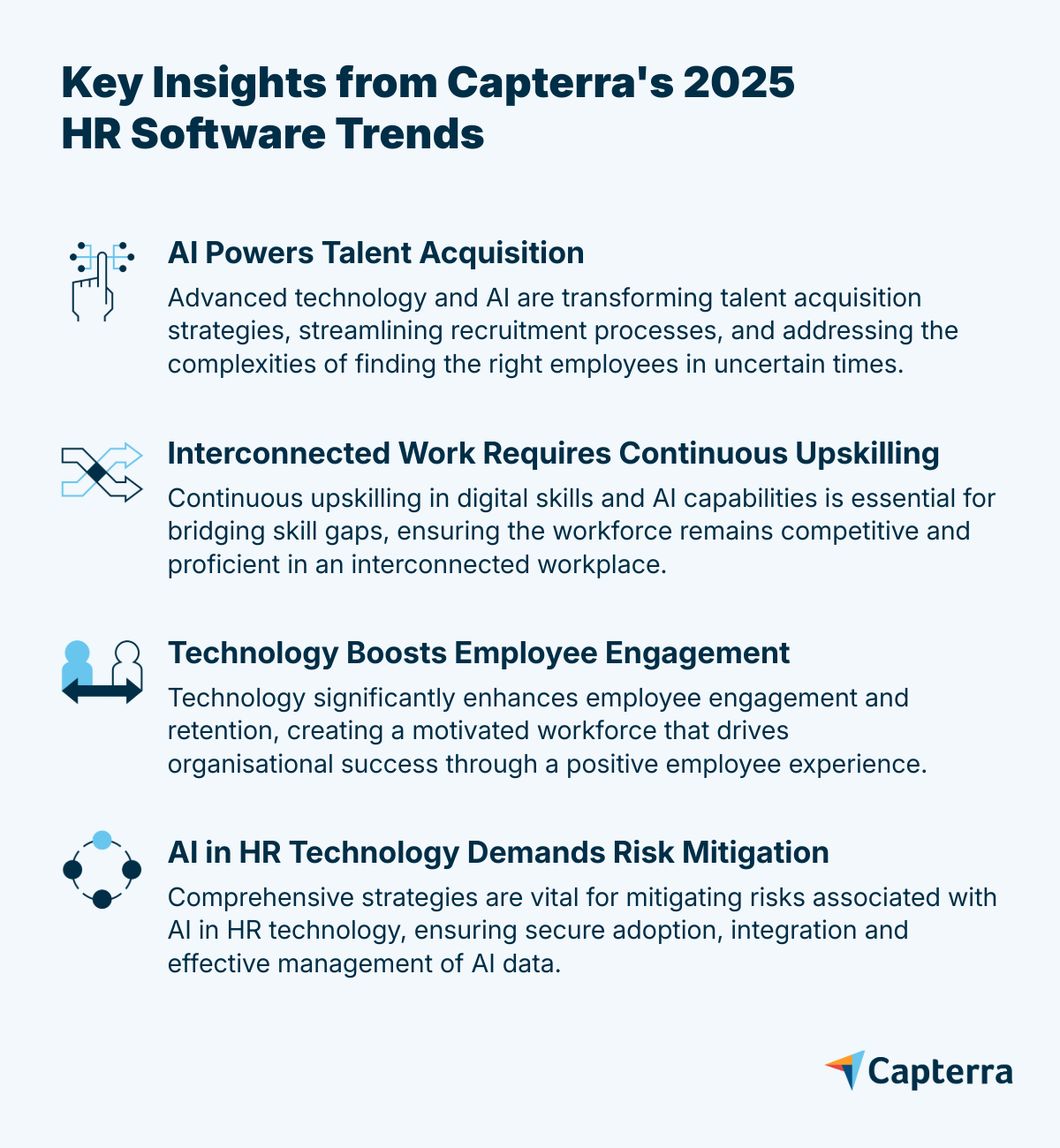
Capterra’s 2025 HR Software Trends Survey—featuring 3,200+ HR professionals in 11 countries, with 296 in the UK—shows how tech is shaping the future, but also helps face major challenges. Four trends stand out: AI is driving smarter hiring, upskilling is a must, tech boosts engagement, and AI brings new risks. With insights from HR tech analyst Brian Westfall and Gartner experts and research, we highlight what’s working and where caution is needed.
The bottom line: Adopting new HR tech isn’t enough. Success depends on building AI skills, protecting data, and keeping people at the centre. This report shows how UK HR leaders can act now to stay ahead.
Key Insight 1: AI Powers Talent Acquisition
The challenge
Finding the right employees in complex times requires innovative approaches. With recruiting costs rising and a demand for skilled professionals, organisations must adapt their strategies using technology enhanced with AI, which aids in talent analytics, volume of applications, candidate experience, and better recruitment outcomes.
Brian Westfall [1], HR technology expert, notes that as the job market shifts, there will be a surge in applicants for each job opening, adding complexity to the screening and hiring process. He highlights that recruiting involves more than just identifying top candidates; it's about engaging with job seekers to prevent pipeline dropouts and ensuring the best candidate experience possible throughout the process.
What UK HR leaders tell us
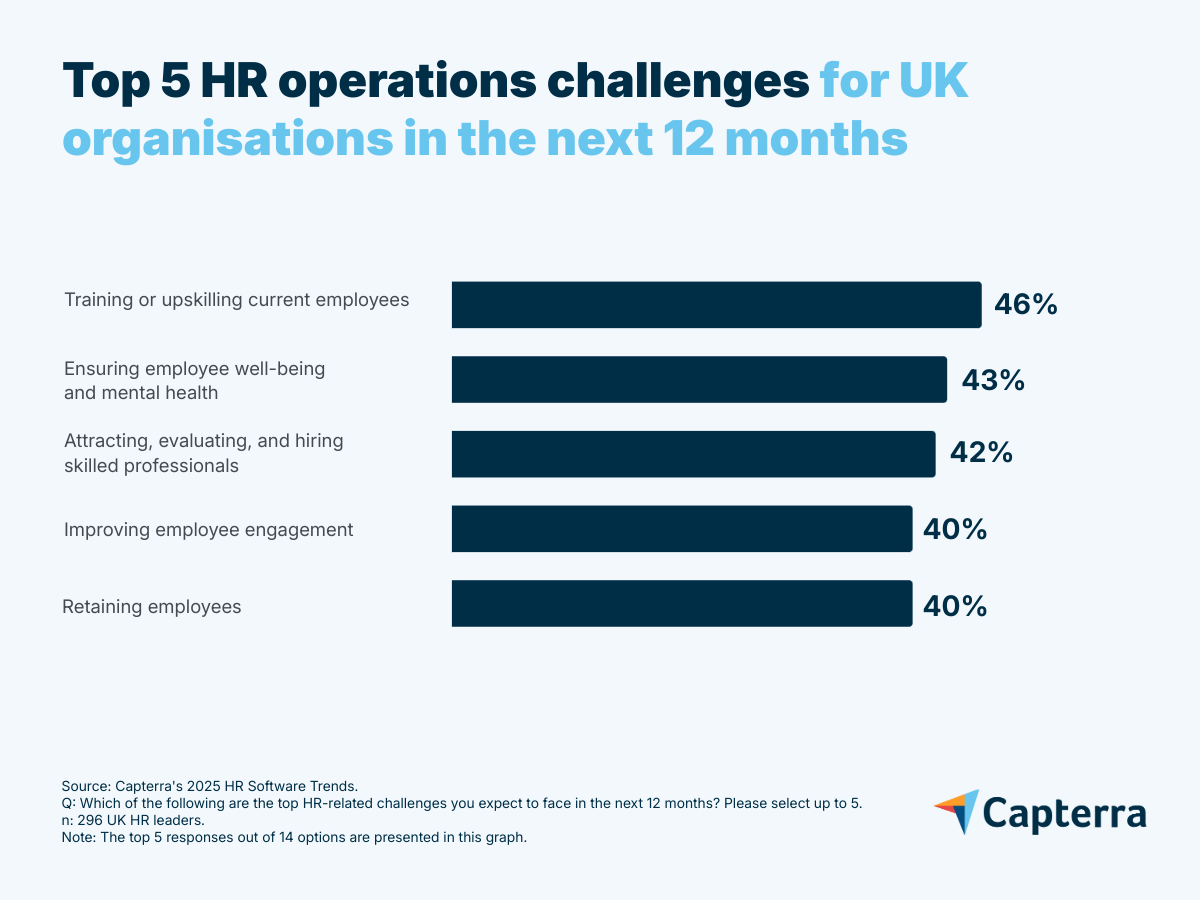
- 46% identify training or upskilling employees as one of the top HR challenges in the next 12 months.
- 70% expect to increase their workforce in the next 12 months.
- 66% foresee recruiting costs increasing compared to last year.
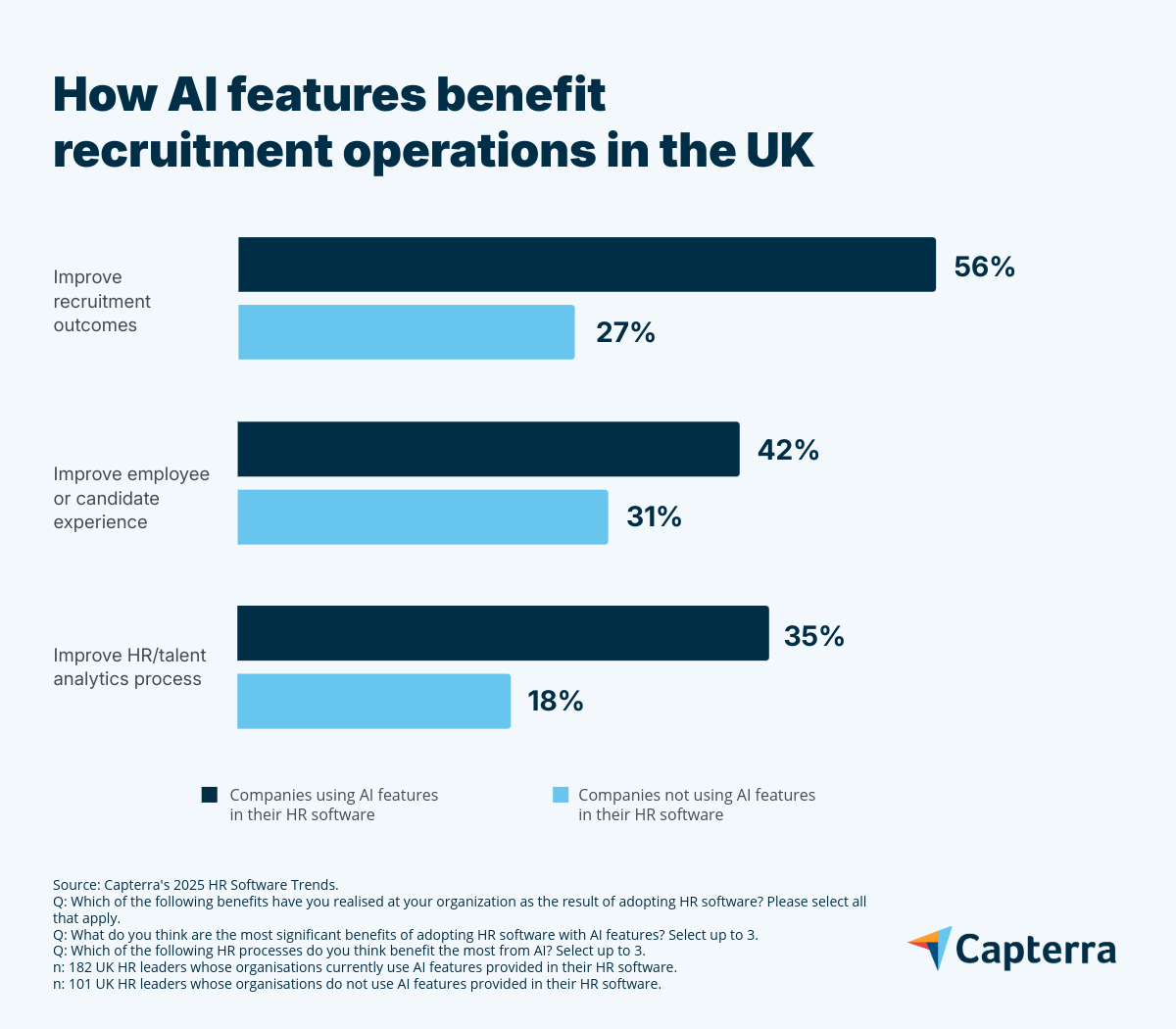
- 29% think that HR/talent analytics is the process that benefits most from AI.
Why it matters
Efficiency is critical when you have less budget and fewer resources, and that's where software can help. Seven in ten HR leaders in the UK anticipate that their organisation’s workforce will grow in the next 12 months, but just half (52%) consider recruiting software critical, despite the process being one of the top challenges for organisations.
However, it is not only about having the technology. HR tools with AI features can help organisations recruit more efficiently and enhance the recruiter-candidate relationship, but soft skills are also needed to engage, connect, and provide a personalised experience to candidates.
The opportunity
AI-driven recruiting improves efficiency, productivity and eventual hires by automating routine tasks and freeing recruiters' time to build quality candidate relationships. It optimises the identification of effective job posting sources and the selection of compatible candidates.
"AI can really help take over some of the more routine tasks. For example, the first initial screening interview, where you're getting the basic details from these job applicants. We're seeing chatbots taking over this step, which is really helpful, because the recruiters can then focus on those more tailored experiences for candidates further down in the pipeline."- Brian Westfall
Recommendations:
- Upgrade recruiting software/ATS with AI features to refine and speed up the early stages of applicant screening.
- Implement AI features in HR/talent analytics to enhance data analysis and candidate evaluation.
- Focus on candidate experience by continuously training your recruiters in soft skills.
-
When implementing AI in recruitment, consider:
- Using AI to support the process, not replace it: candidates still value human interaction and decision-making.
- Being transparent about how AI is used in the hiring process.
- Prioritising candidate experience by offering the option to connect with a human recruiter.
Software solutions
HR talent analytics: These tools help analyse recruitment data and identify compatible applicants. AI features enhance candidate evaluation by providing predictive insights and automating data analysis. Half (50%) of HR leaders in the UK rate this type of software as critical to their HR operations.
Recruiting software and ATS: Both software streamline the talent acquisition process, from sourcing to selection. AI features further improve efficiency by automating resume screening and enhancing candidate matching. 52% of UK HR leaders rate these types of software as critical to their HR operations.
Key Insight 2: Interconnected Work Requires Continuous Upskilling
The challenge
Upskilling is critical in an increasingly interconnected work environment, and 46% of UK HR leaders say they expect to face this challenge in the next 12 months. Moreover, organisations will also have to deal with complex software integration and enhance employees' AI skills.
According to Gartner’s report “Quick Pulse: Leader Sentiment on Skills Gaps,” [2] organisations are increasingly concerned about emerging skills gaps and their potential impact on performance and growth goals. 78% of HR leaders are worried about skills gaps at their organizations, and 56% are most concerned with deficiencies in digital skills. So, part of the challenge is also to identify where these gaps are.
"Identifying skills gaps in an organization can be hard, and you have to do that work in order to understand where to focus your efforts with your training and learning programs."- Brian Westfall
What UK HR leaders tell us
- 46% cite training and upskilling current employees as the main operational challenge in the next 12 months.
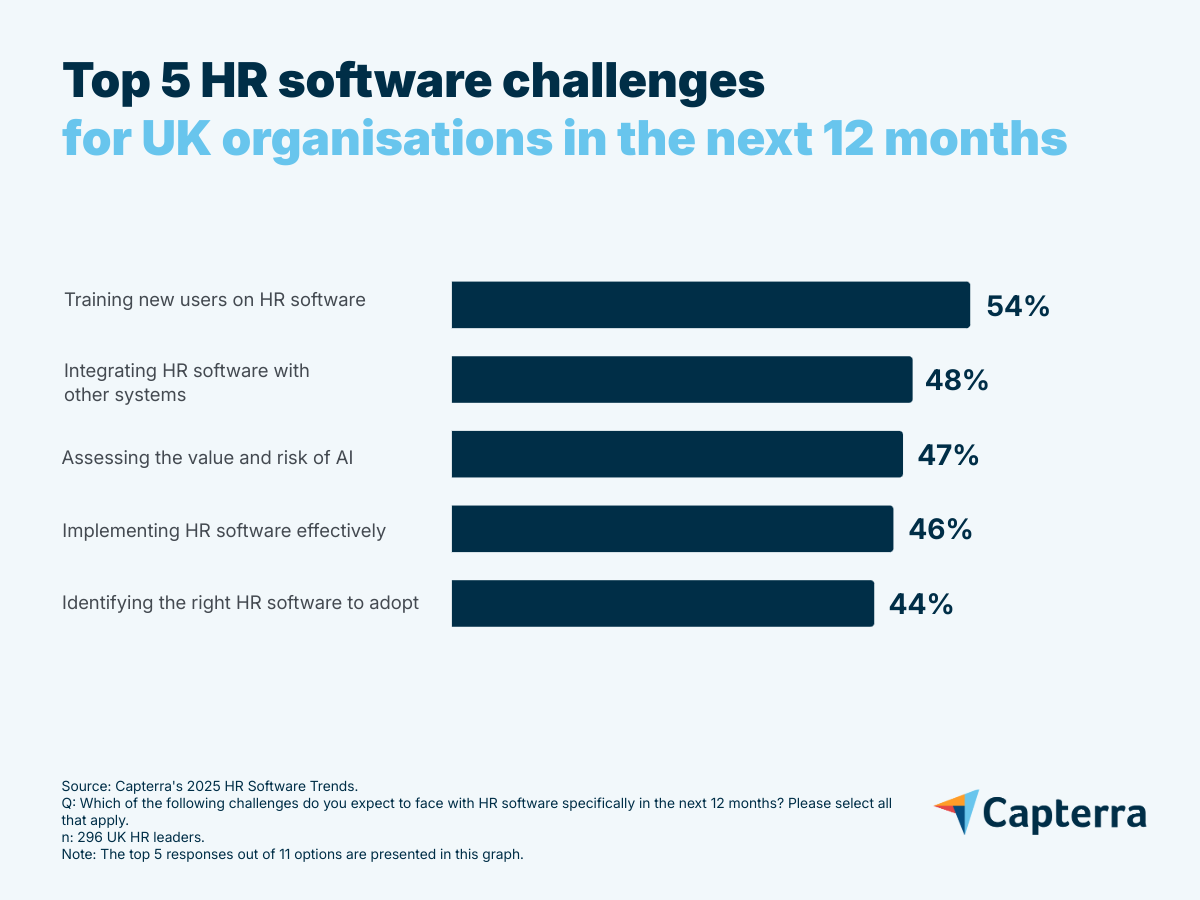
- 54% indicate training new users on HR software as the main software-related challenge in the next 12 months, compared to the global average of 48%.
- 75% expect that their training/upskilling costs will increase this year compared to last year, relatively higher than the global average of 68%.
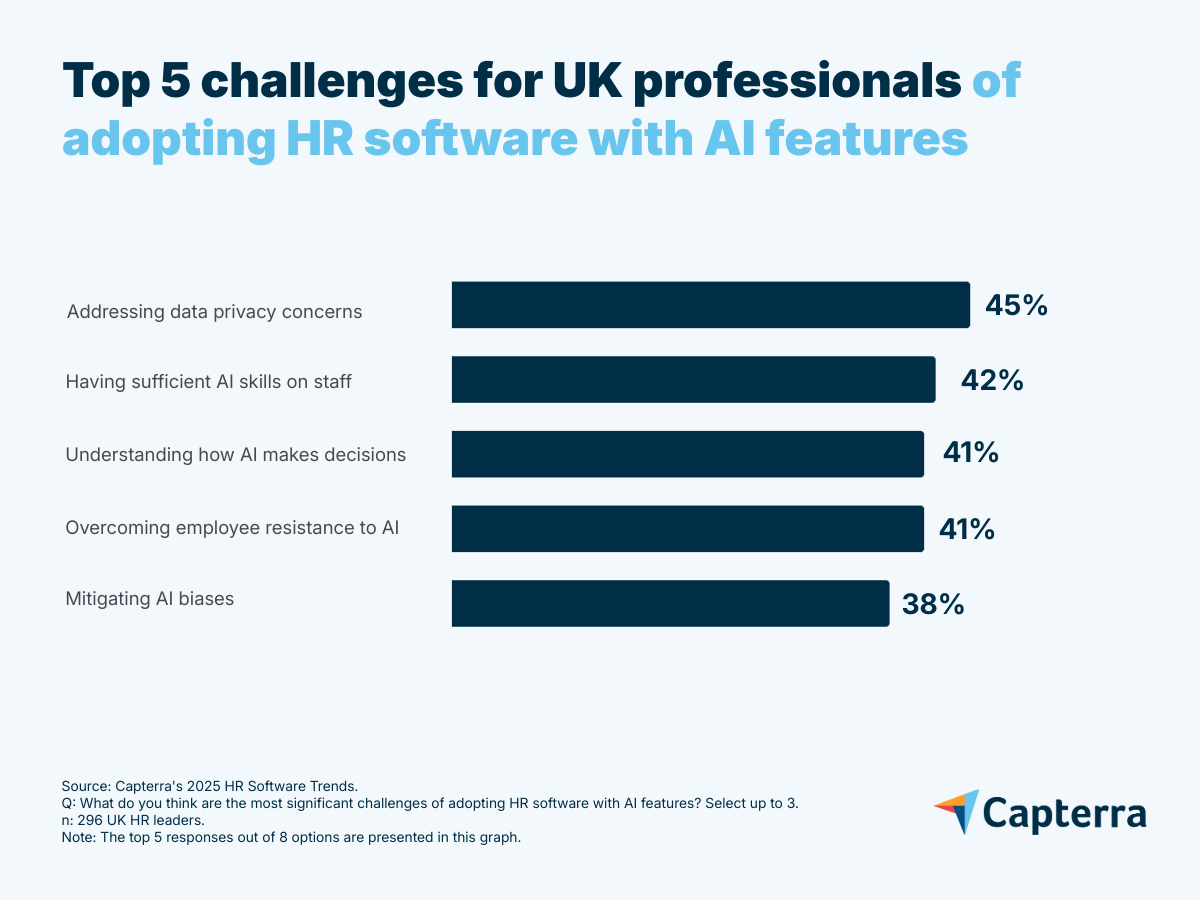
- 42% highlight insufficient AI skills on staff as a challenge when adopting AI features.
Why it matters
Effective integration and skilled staff are crucial as companies juggle multiple systems. This is particularly an issue for UK HR professionals, with companies tending to use more software products than their international peers. On average, UK firms utilise five HR tools compared to an average of four globally. With AI boosting productivity, out-of-the-box software integration, and HR and AI expertise are essential for competitiveness.
Over six in ten (61%) of the surveyed HR leaders in the UK indicated that their organisation already uses AI features in its HR software, and their expectations of AI contribution to HR software have also increased compared to the global average, indicating a growing need for AI-specific skills. In “Agentic and AI Kick-Starter for CHROs”, [3] a Gartner report, HR leaders estimate that generative AI (GenAI) will impact 37% of the workforce and the way people work in the next two to five years.
However, only 45% of HR leaders consider training resources critical when researching software, even when the majority foresee an increase in costs in this field and are aware that they have to upskill their employees.
The opportunity
Organisations can address skills gaps and enhance productivity by focusing on upskilling initiatives and making sure they have effective software integrations, leveraging AI to support these efforts. In the current volatile and uncertain context, upskilling employees can be more productive and faster for companies than looking and hiring for specific roles.
"You see a lot of companies moving that budget from hiring more people towards upskilling, because that is going to be more cost-effective in the long run."- Brian Westfall
Recommendations:
- Ensure current or upgraded software integrates with the company's HR tech stack.
- Leverage talent management/analytics to ensure smooth software integration and optimise AI capabilities.
- Develop comprehensive training programs: Collaborate with leaders and software users to create ongoing upskilling initiatives.
- Invest in workforce training technology, focusing on integrations and AI features, and upgrade the software if needed.
- Regularly monitor the effectiveness of integrations and employee performance/skills.
Software solutions
Human resources information system (HRIS): This type of tool centralises HR data and supports integration with other systems. AI features help automate data sync and enable real-time insights. 55% of HR leaders in the UK rate this type of software as critical to their HR operations.
HR/talent analytics: These tools help identify and address employee skills gaps. AI features can help design personalised upskilling paths. 50% of UK HR leaders rate this type of software as critical to their HR operations.
Learning management system (LMS): This kind of system supports ongoing training and upskilling in HR software and AI skills. AI features can help create content and templates and personalise the user experience. 48% of HR leaders in the UK rate this type of software as critical to their HR operations.
Key Insight 3: Technology Boosts Employee Engagement
The challenge
Boosting employee engagement and retention is a top HR priority for HR leaders in the UK. Identifying the employee experience areas to improve is key, as it drives engagement and, in turn, increases retention.
"Engagement and retention are always going to be one of the biggest priorities for any HR department in any organisation. It comes down to really looking at the entire employee experience. Because employees will leave an organisation for a lot of different reasons."- Brian Westfall
Using and efficiently integrating tools like compensation software, employee engagement, and benefits administration is crucial for creating a motivated and committed workforce.
What UK HR leaders tell us
- 40% identify improving employee engagement, and retaining employees as among top HR challenges for this year.
- 55% of AI features users in HR software report that they help increase employee satisfaction or engagement, compared to only 38% of non-users of AI features.
- 45% of AI features users in HR software report that they help increase employee retention, compared to only 39% of non-users of AI features.
Why it matters
Retaining and engaging skilled employees is key as they are valuable assets who not only perform well but can also train others and drive organisational success. Losing them would mean incurring additional recruitment and training costs and efforts. It is essential to focus on strategies that keep key employees motivated and committed by enhancing their overall experience within the organisation.
"Engagement and retention are always going to be a priority, right? When times are good, there are many job opportunities that give employees an excuse to leave one organisation for another. And then, when industries are struggling, that's also an excuse for employees to leave that industry. So companies are always hyper-aware of how to engage and retain their employees."- Brian Westfall
The opportunity
By leveraging technology, organisations can significantly enhance employee engagement and retention. Adopting HR software has led to higher satisfaction and retention rates, while AI features enable the software to provide better insights and, ultimately, enhance employee experience.
Recommendations:
- Brian Westfall recommends regularly conducting surveys to assess engagement levels, pinpoint areas for improvement, and continuously monitor the employee experience (benefits, learning, and growth opportunities). This can help develop plans to enhance employee engagement.
-
According to Gartner’s “2025 HR Technology Employee Experience Bullseye” report [4], to improve employee experience, HR leaders should:
- Identify which HR tasks employees prefer to handle in person versus through self-service platforms to better meet their needs and enhance their experience.
- Invest in internal career sites and talent marketplaces to support career growth and retention.
- Focus on user-friendly HR tech to conveniently gather employees' sentiment.
- Promote well-being tool adoption by tailoring offerings to generational preferences, with a focus on mental well-being tools for millennial and Gen Z employees.
-
To support employee retention, HR leaders can leverage the following strategies:
- Use performance management software to analyse employee performance, recognise and reward them accordingly with compensation management tools.
- Use benefits administration software to offer personalised advantages that meet employee needs and maintain work-life balance.
- Leverage talent management software to provide growth opportunities, encourage skill development, and foster career advancement, keeping top talent committed.
- Employees are more likely to stay engaged with the organisation if the management supports their career paths and helps them develop their skills.
Software solutions
Compensation management software: Design competitive pay structures to retain skilled employees. AI can help you benchmark compensation against market data and predict turnover risks based on pay satisfaction. 38% of UK HR leaders rate this type of software as critical to their HR operations, which is below the global average (45%).
Employee engagement software: Foster morale and recognise employee achievements. AI-driven nudges and recognition algorithms can help managers engage employees more consistently. 46% of HR leaders in the UK rate this type of software as critical to their HR operations.
Survey software: Collect employees' feedback on what they are missing to feel more engaged. AI features can analyse sentiment and discover patterns in employee concerns.
Key Insight 4: AI in HR Technology Demands Risk Mitigation
The challenge
Nearly half of UK HR leaders cite the assessment of AI value and risk (47%) and effective software implementation (46%) as top HR software concerns. In the UK, professionals are also more uneasy about the risk of privacy issues of using AI features in HR tools than in other countries surveyed. Aside from this and possible AI skills gaps among staff members, the main concerns for UK HR leaders regarding artificial intelligence are understanding AI decision-making and overcoming employee resistance to AI.
Organisations must understand the security risks associated with AI, as it will handle information provided from multiple sources (e.g., employees, clients, other software). Skilled employees and the right technology and processes will ensure data integrity.
"You don't want to rush with AI. You want to implement and use those features when you're ready as an organisation because you don't want to have AI working off bad data. You don't want your users using AI for things that they shouldn't."- Brian Westfall
What UK HR leaders tell us
- 46% in the UK expect effective HR software implementation to be a key challenge they face in the next 12 months.
- 47% are concerned with assessing AI's value and risks.
- 75% consider security a critical feature when researching HR software to acquire and implement, while 46% report that security concerns triggered HR purchases last year.
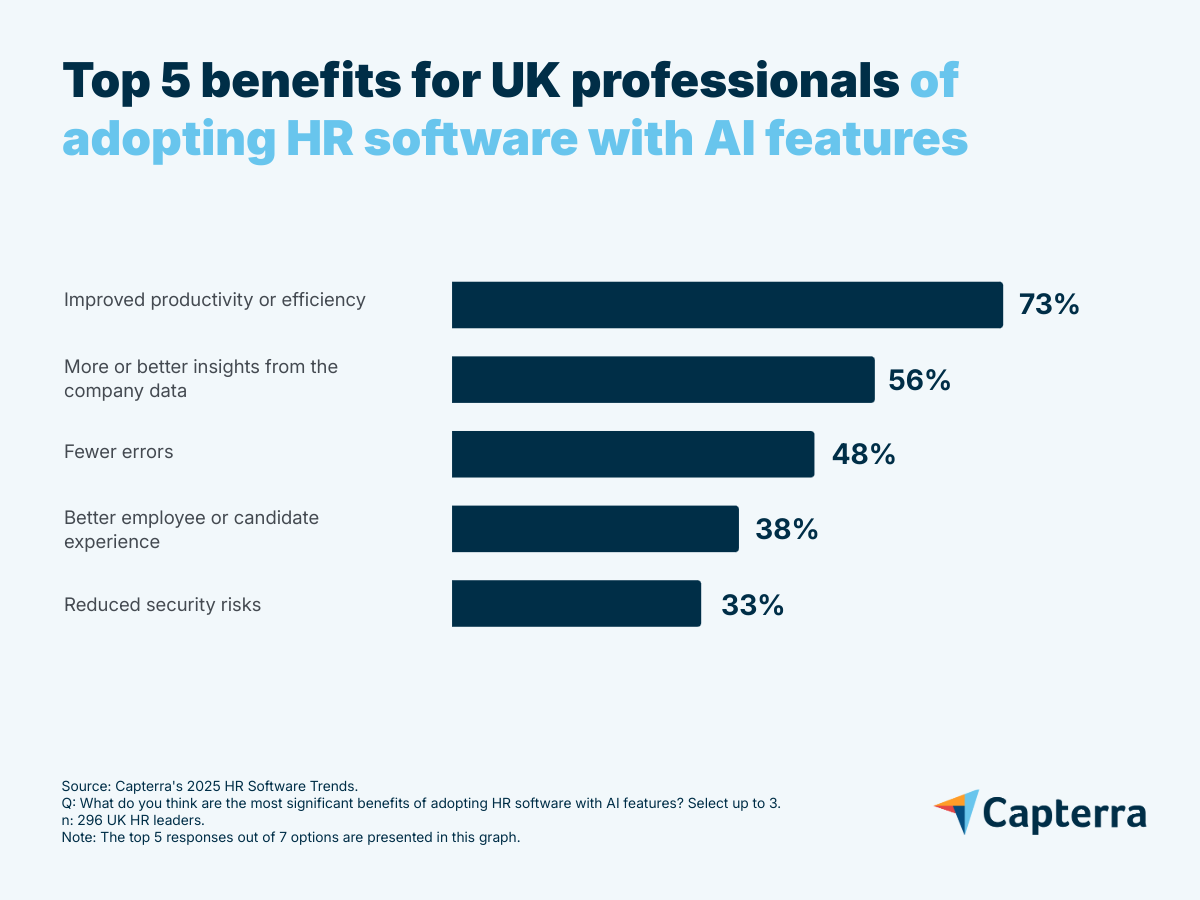
- 37% of AI users in the UK say reducing security risks is a benefit of adopting HR software with AI features.
Why it matters
AI features must rely on high-quality data and compliance, making data protection and an understanding of AI decision-making crucial for minimising risks. Successful HR software implementation prevents disruptions and secures data. Efficient integrations protect privacy by reducing vulnerabilities. AI literacy is key to understanding how AI works.
Jonah Shepp, Senior Principal, Research, at Gartner, warns that AI, especially generative AI, poses privacy, intellectual property, and trust risks. HR leaders should address these, as employee behaviour is key to preventing data leaks, which could have serious legal and reputational impacts. [5]
The opportunity
Implementing software properly, maintaining data quality, and understanding how AI works all help to mitigate risks of AI. HR software with AI features helps reduce security risks, but effective data privacy and management are also crucial for protecting sensitive information and ensuring compliance.
Eser Rizaoglu and Stephanie Clement, both Senior Director Analysts, state in Gartner’s “Agentic and AI Kick-Starter for CHROs” report [3] that cultivating AI literacy—the knowledge and skills to effectively work with AI—is essential for successfully scaling AI within an organisation. Without it, organisations are unlikely to achieve value creation with AI.
Recommendations:
- Ensure staff effectively use HR software integrations and understand AI functionalities; implement training programs if necessary.
- Conduct comprehensive data audits to verify data quality, correct usage, and alignment with business expectations.
- Revise data policies to ensure high-quality input and compliance with privacy rules, crucial for both general and AI-enhanced systems.
- Upgrade security features in HR software to safeguard employee data and manage AI-related risks; consider changing the product if necessary.
- Establish clear usage guidelines and regularly assess software functionality and ease of use to improve productivity and reduce user errors.
Software solutions
HR/talent analytics: Leverage these tools to help analyse and improve employee data governance policies aligned with AI data usage. AI features can generate role summaries and risk insights to help organisations quickly evaluate whether user-role assignments are appropriate and compliant. 50% of HR leaders in the UK rate this type of software as critical to their HR operations.
Learning management system (LMS): Use LMS to train employees on data collection and AI usage. AI can personalise learning paths based on employee roles and knowledge gaps, ensuring targeted upskilling in data and AI literacy. 48% of UK HR leaders rate this type of platform as critical to their HR operations.
Data management software: Manage and ensure the quality of data used for the HR software and AI applications. AI features can automate data cleansing and validation processes, reducing human error and ensuring high-quality inputs for AI systems.
Data privacy software: Monitor and enforce adherence to data privacy regulations. AI features help in real-time compliance tracking and automated enforcement of privacy policies.
Adapting HR to Technological Shifts
The future of HR will be defined by how well organisations adapt to rapid technological change and evolving workforce needs. Embracing AI, prioritising upskilling, and safeguarding data are now essential for success. HR leaders who act on these trends will be better equipped to attract, develop, and retain top talent. By keeping people at the centre of every tech decision, organisations can thrive in an increasingly complex world.
Note: The applications mentioned in this article are examples to show a feature in context and are not intended as endorsements or recommendations.
Sources
- Brian Westfall, LinkedIn
- Quick Pulse: Leader Sentiment on Skills Gaps, by Trisha Rai, February 2025, Gartner
- Agentic and AI Kick-Starter for CHROs, by Eser Rizaoglu and Stephanie Clement, June 2025, Gartner
- HR Technology Employee Experience Bullseye Report, 2025, by Nini Longoria, April 2025, Gartner
- HR Leaders Must Understand the Opportunities and Risks of Adopting AI and GenAI Technologies: Act Now to Prepare for the Future of Work, by Jonah Shepp, December 2024, Gartner
*Methodology
Capterra's 2025 HR Software Trends Survey was conducted in April 2025 among 3,256 respondents in Australia (n=278), Brazil (n=300), Canada (n=289), France (n=300), Germany (n=300), India (n=294), Italy (n=300), Mexico (n=300), Spain (n=300), the U.K. (n=296), and the U.S. (n=300). The goal of the study was to understand the HR software that companies are buying, their benefits and challenges, and the impact of AI on HR. Respondents were screened for employment at companies with more than one employee, working in management-level roles or above. Respondents were also confirmed to be at least partially responsible for HR software purchase decisions within their organisation.